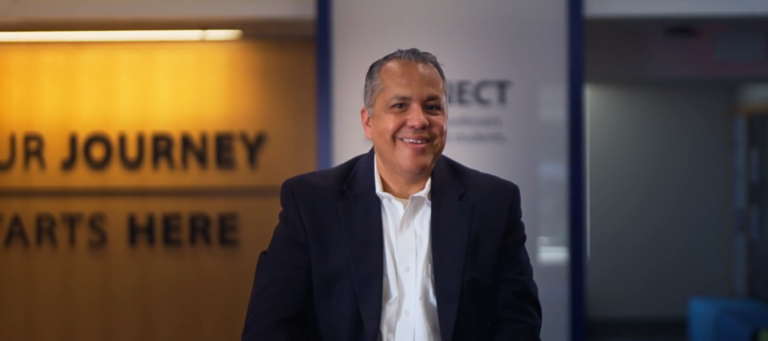
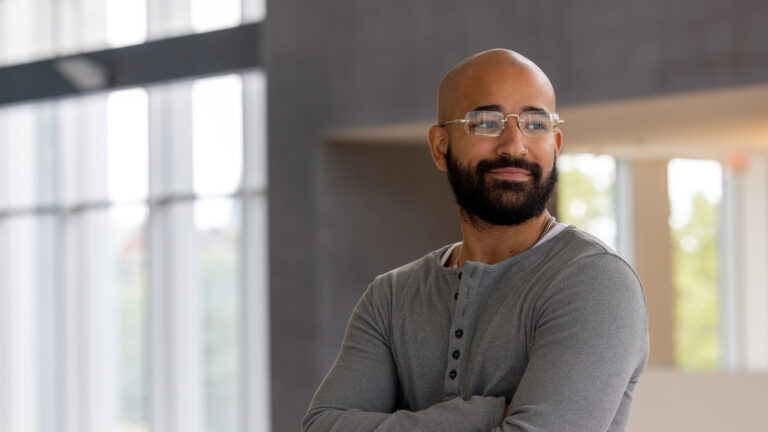
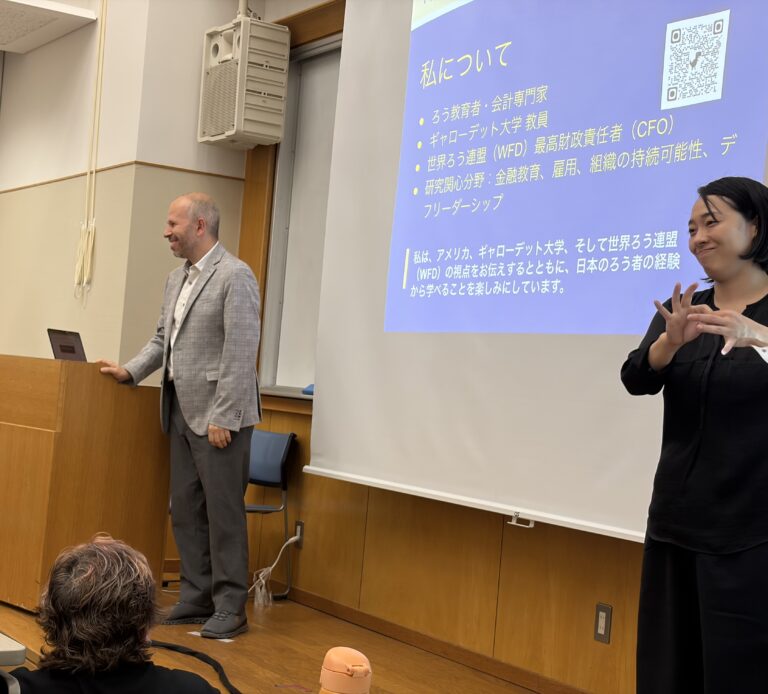


Nyle Dimarco, ’13, is one of the most visible Deaf leaders in media and entertainment. He has tirelessly used his platforms in the entertainment industry to highlight Deaf culture and language for mainstream audiences.
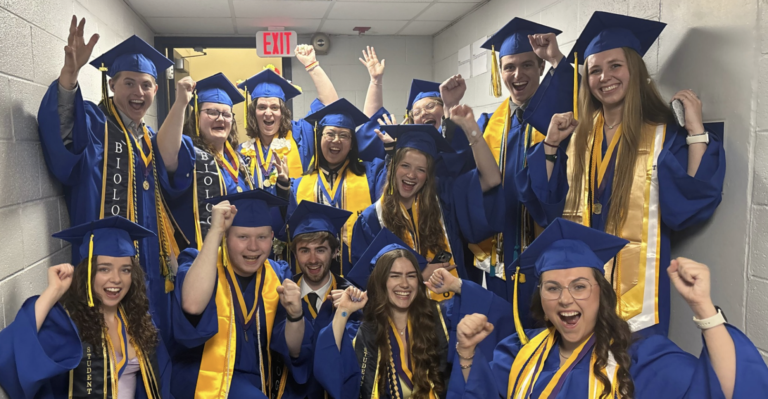
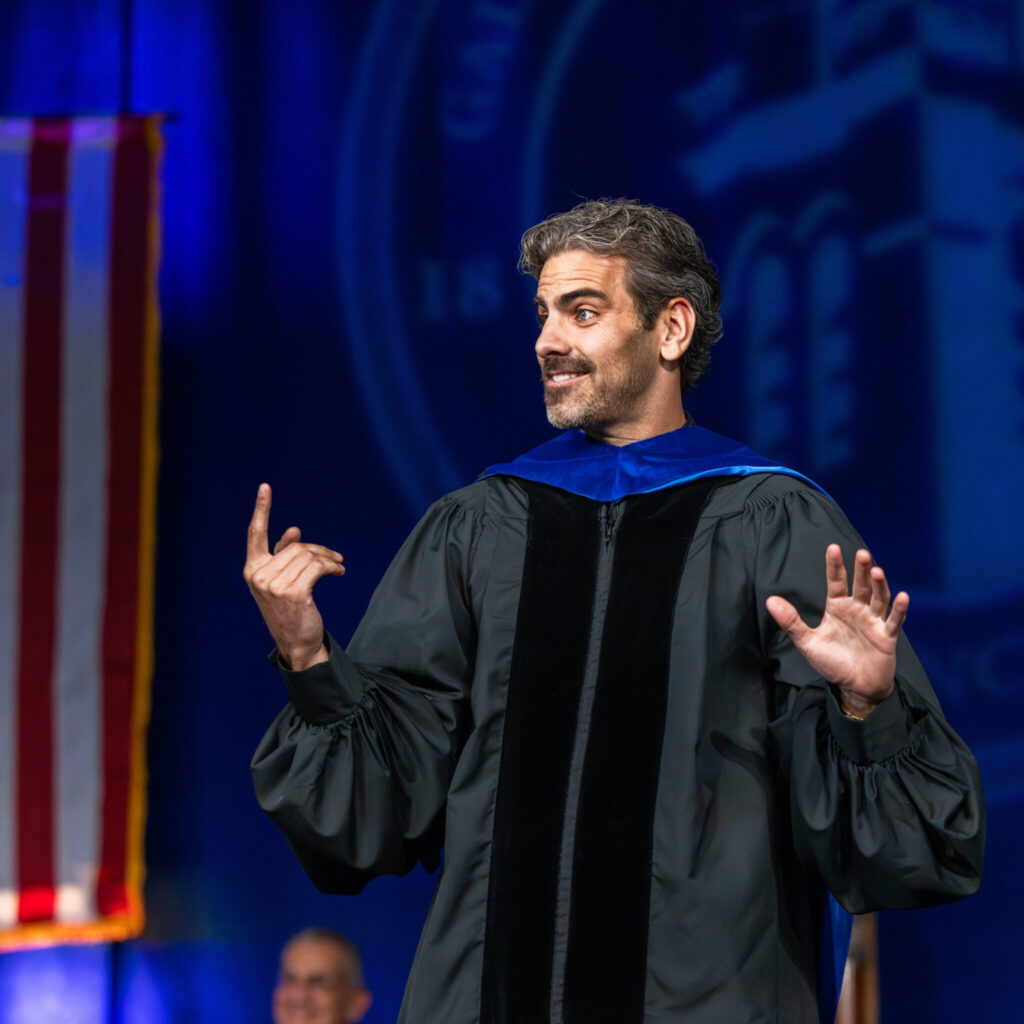
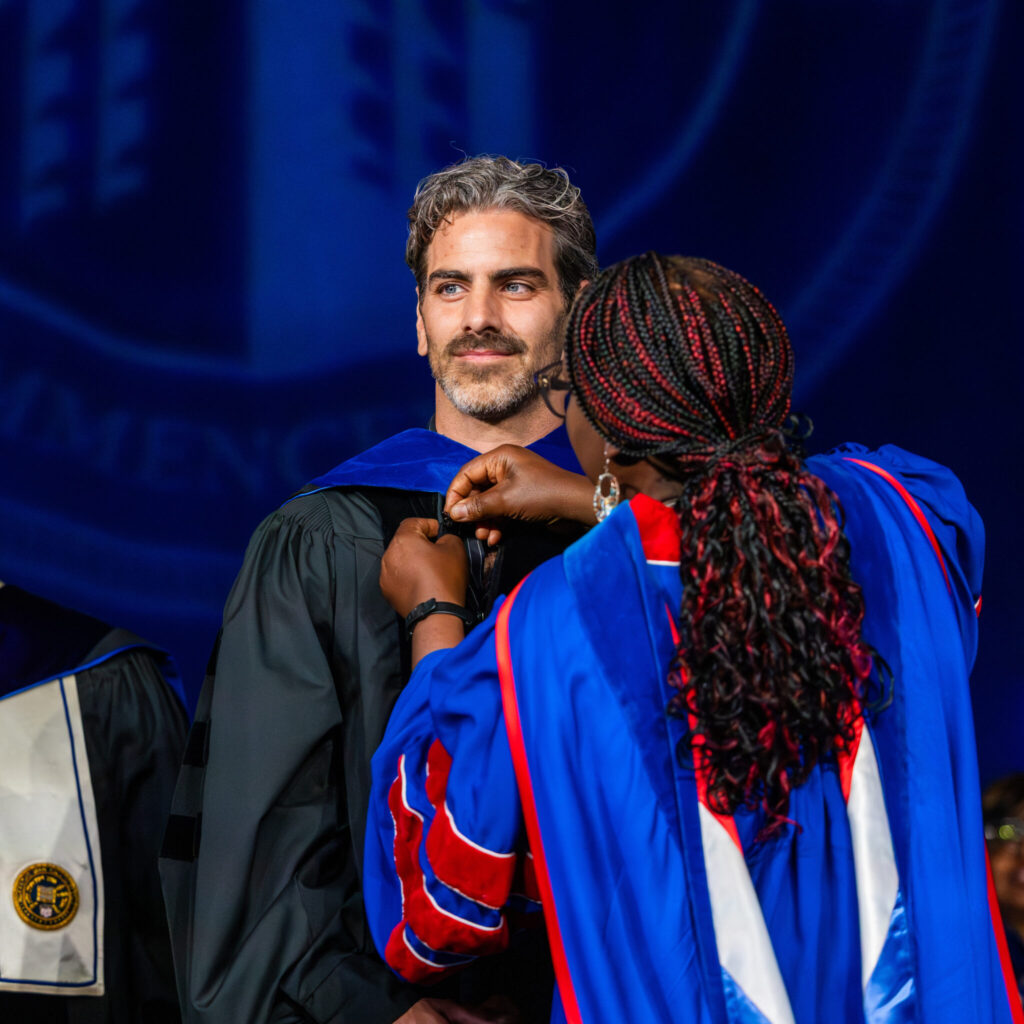
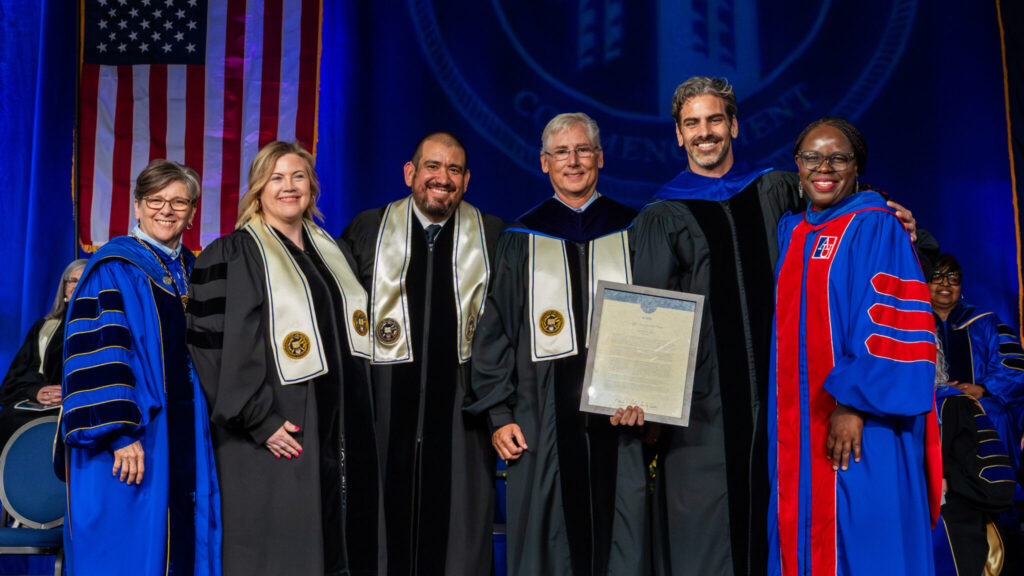
DiMarco received an honorary Doctor of Arts at Gallaudet’s Commencement 2026 ceremony. He also gave the undergraduate commencement address.
The text of DiMarco’s address is shared below. Video of the address can be viewed in the recording of the Commencement 2026 Undergraduate Ceremony.
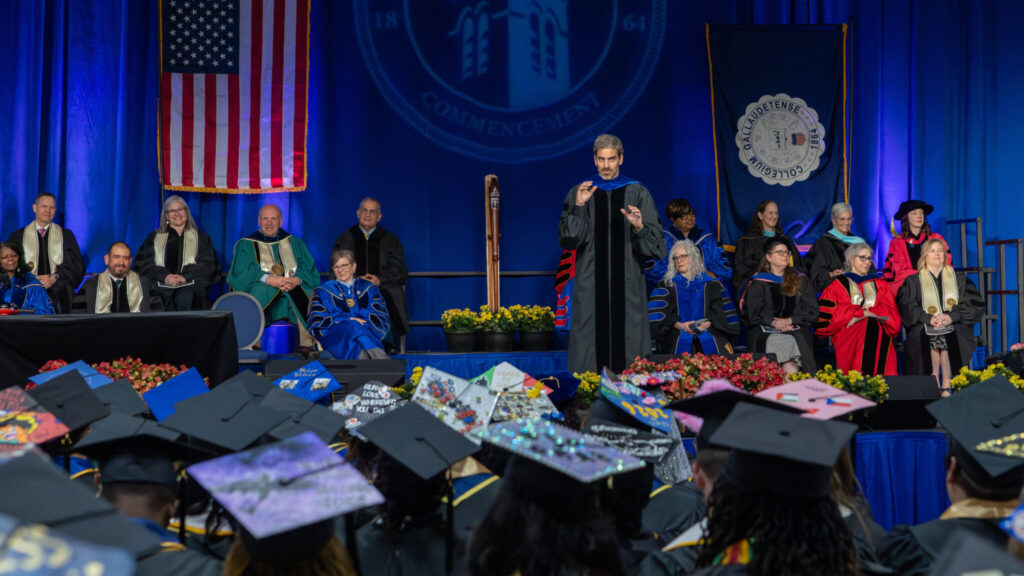
This might be my most terrifying moment. I’ve gone on live TV many times while millions watched, but there is nothing quite like standing in front of my own people.
I have to confess something. I never had a moment like this one. I missed my own graduation, if you can believe it. I told myself I was ready. I was in a hurry to drink up the world. I thought I was too good for one more day on this campus.
I was wrong.
I wish I had walked alongside my classmates. I wish I had taken one more breath here. Sometimes I even get nightmares that I never finished college just because I never walked. So right now, being here with you, this feels like a full circle moment. Hopefully, now I won’t have any more nightmares!
Gallaudet is a magical place.
I remember my first night at Gallaudet. It was around 3 a.m. I was walking back from an off-campus party. In a group, mind you. You couldn’t really walk alone around here back in 2007.
As I passed through campus, I came upon the statue of Laurent Clerc. I stopped. I looked at him. It felt like he was looking at me.
I thought to myself, “Wow, if not for this man, there would likely be no Gallaudet. And I would not be standing here.”
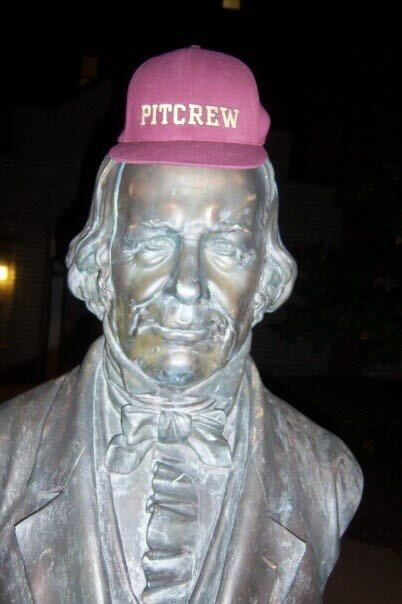
I took off my favorite hat and placed it on him. Took a picture using a digital camera I carried around. There were no iPhones back then.
I still have that picture on my phone today. It’s in my Favorites. I look at it all the time. Back then, I knew the moment was special… I just didn’t know exactly why, yet.
Before graduating high school, I applied to only one university. I gambled. Why? Because of Gallaudet’s legacy. But also because of something that happened in 5th grade.
I spent a year alone in a public school. And it was isolating. Every day, I was branded as “the deaf kid.” I couldn’t just be a kid. Sure, I made friends, but communication was always rudimentary. Always effortful. I couldn’t participate in activities. I couldn’t thrive.
So, ever since 5th grade, I knew I wanted to come here. Because Gallaudet is a utopia.
At Gallaudet, you meet deaf people from all over the world, with different sign languages, different cultures, and different backgrounds. But we never fail to connect through our shared experience.
When Gallaudet was signed into law in 1864, we were given land just outside of Florida Avenue, which was then called Boundary Road. The city was within those limits. Outside of Boundary Road? Farmland. And us.
What that meant: they wanted to give deaf people education, but still wanted us to remain unseen. Outside the city. Outside the boundary.
Outsiders.
Remember that word. It will come back.
I have to be honest with you. I was a mediocre student here. I was a math major. I wanted to teach.
But here’s what I owe Gallaudet. It’s the only university for the Deaf, which means it’s small, tight-knit, and oddly full of possibility. It let me wander. I tried on jobs I never planned for. I even lifeguarded here. Why? Why not?
I did a lot here. I jumped around. People asked me to fill positions. To help. To try. Gallaudet gave me something that would become my greatest asset in the real world: adaptability.
I remember stepping outside of Gallaudet for the last time thinking, I will never experience a place like this again. The utopia of it all.
A year after graduating, my first real opportunity in Hollywood came when I was cast on “Switched at Birth”. I was so excited. It was a small role, but I knew it could become recurring if they liked me. I would be the love interest to the lead. This was my foot in the door.
The creative team liked my audition and asked if I was based in Los Angeles. I said yes. I was not. I was living right here in Washington, D.C. I bought my own flight to L.A. I had just finished college and It felt like a fortune. But that’s how badly I wanted it. That’s how much I believed in what was possible. I got the script and started memorizing my lines. Naturally, I had questions. Not about the character, but about the ASL and what signs I should use.
My character is conversing with a hearing character who only recently learned American Sign Language (ASL). Obviously, I thought to code switch, the way any Deaf person would when conversing with a hearing person who knows rudimentary ASL.
When I went to discuss this with the director, he said he didn’t know ASL. He was hearing. And he sent me to the ASL master. I went to find the ASL master and asked if I should code switch for accuracy. He told me to just sign fluently because it’s for TV.
Something didn’t sit right with me. That ASL master was hearing. A hearing person was telling me how to use my own language.
I looked around. The director. The producers. The writers. All hearing. Here I was on a show about the Deaf community, and not one person in a position of power was Deaf.
It was such a stark contrast going from Gallaudet to Hollywood. Here at Gallaudet, everybody was Deaf. Professors. Administrators. Leaders everywhere. I had grown up surrounded by Deaf excellence. Now I was being hit by the limitations of a hearing world.
Now, don’t get me wrong. 2014 was a different time. At the time, Switched at Birth really put Deaf people on the map. Freeform (then ABC Family) gambled on a deaf TV show. It was the first deaf show ever. It brought ASL into living rooms across America. It started conversations that had never existed before.
After my time on “Switched at Birth”, I waited for a callback about an expanded role. But nothing came.
And then one day, I got a message on Instagram. America’s Next Top Model wanted me. I thought it was a scam. DMs were still new at that time. I had never modeled. I had never danced (well, I don’t count clubbing as dancing). Then I remembered my time at Gallaudet. I was a lifeguard. I tried many different things I never planned for. That adaptability was a part of Gallaudet.
So I said yes.
I also understood that shows like “America’s Next Top Model” and “Dancing with the Stars” were stages. Massive stage. And I could use that.
Not just for my own gain. Or to win. But to reframe what the world thought about deaf people. To bring our stories, our experience to 50 more million people who had never thought about us that way before.
After winning both shows, I thought that things would come easily. I was wrong.
I met with a lot of directors, writers, and producers. They loved me. They wanted to work with me. But then came the same words, over and over again.
“We don’t know how to write you in.”
Let that sink in. They loved me. But they didn’t know how to include me. They didn’t know any Deaf writers. Any Deaf directors. Any Deaf producers. There were almost none 10 years ago. Zero.
Progress is real…but so is the work that remains. I thought about the Deaf President Now students. They came to the Deaf Mecca, only to find that the people in power were hearing. They protested by saying: “This is our place, our education, our community, and we deserve to be led by one of our own.”
And then I thought about Boundary Road. They gave us education, but put us outside the city. Unseen. And now here was Hollywood—willing to make a show about us, but putting us outside the creative room. The director, the producers, and the writers. All hearing. Making decisions about our stories. Our lives. Our community.
Sound familiar?
I thought about that night. That statue. Laurent Clerc looking back at me. I thought about my experience here. How I dabbled in a lot. I tried things, failing at some and excelling at others. But I was never afraid to explore at Gallaudet.
So I thought, “Why not try something new again? I can take the lead.”
That’s why I founded Clerc Studio. Named after one of our own, because everything we build should point back to where we came from.
The mission was simple: produce deaf stories, and hire deaf creatives to tell them. On “Deaf U”, more than 50% of the crew was deaf. Our Audible documentary received an Oscar nomination for Best Documentary Short.
And then came Deaf President Now!. 40 deaf crew members, and for the first time in Hollywood history, a position called the Deaf Lens Producer. It had never existed before. We didn’t just tell a deaf story. We balanced the power dynamics behind the camera.
I remember stepping out of Gallaudet thinking that I would never feel that utopia again. But with every Deaf creative given a seat at the table, I am inching closer.
That is what Gallaudet prepared me to do. Not just to survive in the hearing world, but to change it.
I came here as a math major who wanted to teach. I may not be an educator now, but I never stopped teaching. I just have a bigger classroom through TV and film.
Class of 2026, when you leave this place, remember what Gallaudet gave you. Adaptability. Identity. The courage to explore. Those are your greatest assets.
The hearing world will not always know how to write you in. That is not your limitation. That is the limit of their imagination.
After you graduate, be your most authentic Deaf self. Go change things. The world needs exactly that. Stay true to yourself. Stay true to Gallaudet.
Class of 2026, congratulations! You did it!
To get the latest updates from Nyle DiMarco, follow @nyledimarco on Instagram.