

“We all know cancer screenings save lives,” explained Dr. Poorna Kushalnagar, ’93, as she started her presentation for the NIH Common Fund’s Discovery Dialogues Webinar Series on Wednesday, May 6. Kushalnagar, Director of Gallaudet’s Center of Deaf Health Excellence (CDHE), was the first of two grantees to be featured in this new series, which aims to highlight innovative and high priority projects supported by the NIH Common Fund.
Kushalnagar’s presentation, “Using Community Health Navigators to Advance Cancer Screening Adherence for all Americans who use American Sign Language,” allowed her to highlight the important work CDHE has done to improve health care for Deaf, DeafBlind, and Hard of Hearing (DDBHH) patients.
The inaugural webinar’s theme was “Transformative Approaches to Address Health Disparities,” and also featured a presentation from Dr. Gabriela Buccini of the University of Nevada, Las Vegas, who studies maternal-child food insecurity. (For a full list of Transformative Approaches to Address Health Disparities grantees, see here.)
Tackling the problem
After an introduction by NIH’s Dr. LeShawndra Price and Dr. Vivian Ota Wang, Kushalnagar launched into explaining how communication barriers consistently lead to delayed diagnoses, less preventative care, lower screening rates, and worse health outcomes for DDBHH adults. To provide an example, Kushalnagar showed a video clip of a Deaf woman sharing her experience with cancer treatment with interviewers Chisom Ofamata, a Mellon Fellow at Gallaudet and research associate with CDHE, and student Hiruni Hewapathiranage-Mayadunne, a CDHE research assistant. Although the Deaf woman said she had asked questions, and she had a well meaning doctor who attempted to help by drawing pictures, she struggled with really knowing what was happening. The woman in the video said, “I went through the motions without understanding the full details.” As Kushalnagar noted, this is a common complaint, and it shaped how CDHE developed its project to improve access.
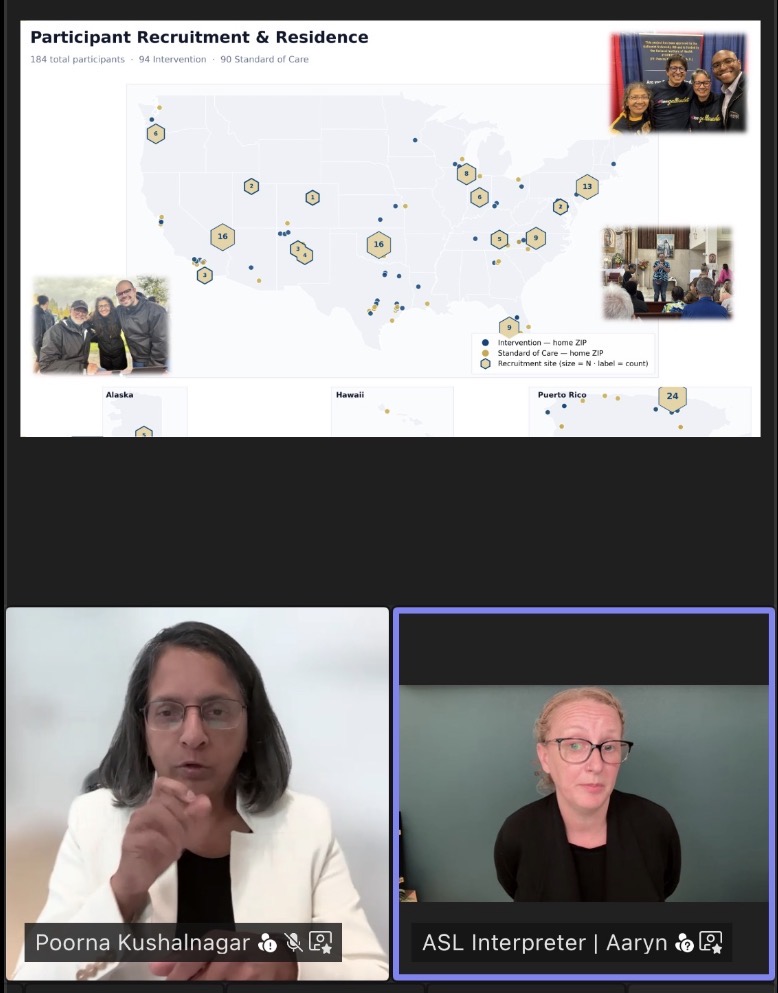
When designing the study, Kushalnagar and her team made it a priority to build as many relationships as possible and to find participants at events, conferences, and elsewhere in their communities. “We did not wait in a clinic for participants to come to us,” she said. The team traveled and recruited from all over the country and provided all of their materials in both ASL and English.
Participants who were paired with ASL-fluent community health navigators met with them over videophone. Together, they selected a screening to tackle, and then they role played to practice conversations that could come up at appointments. The support continued for several months, so the navigators were available even after scheduling delays and other issues.
Better communication, better results
The results were even more promising than CDHE had predicted — 91 percent of those paired with a navigator were screened as opposed to just 67 percent of the patients who received standard care. Kushalnagar said the navigator group also reported that their overall communication with doctors improved.
This is especially critical given that CDHE discovered that 28 of their participants believed they had never been screened for cancer, even though they had. “That speaks to how that information is handled after the screening takes place,” explained Kushalnagar, who noted that they never would have realized this discrepancy if the CDHE team had not been language-concordant with the participants. Communicating in a shared language proved to be of the utmost importance.
During a question and answer session that followed, Kushalnagar suggested several changes that doctors could implement to improve communication with DDBHH patients, including asking for preferred communication methods when appointments are scheduled, arranging to have interpreters and Certified Deaf Interpreters available in case they are needed, not relying on family members to fill out paperwork, adding ASL videos to results in patient portals and secure emails, and ensuring that providers review screening results at follow-up appointments. “We need to make it happen,” Kushalnagar added.
The Center of Deaf Health Excellence website features several cancer screening videos in ASL and other resources.