



Deaf and hard of hearing people have always known that being deaf or hard of hearing gives them unique strengths and perspectives. The concept is now widely known as Deaf Gain, but the belief has existed for hundreds of years.
In 1779, a deaf man in Paris named Pierre Desloges defended a local school’s use of sign language to educate deaf children. His book serves as an early testament to Deaf Gain.
“Nature has not been as cruel to us as is commonly believed: she always compensates in one sense for what is lacking in the others,” Desloges wrote. “The deprivation of hearing generally makes us less distracted. Our ideas, concentrated, so to speak, within ourselves, necessarily lead us to meditation and reflection. The language we use…is vivid: feeling is depicted in it; imagination unfolds within it. None other is more suited to conveying in the soul of great and strong emotions.”
Deaf Gain was here “all along,” says Dr. H-Dirksen Bauman. In 2010, Bauman and Dr. Joseph J. Murray took the deaf community’s collective belief and developed it into a full-fledged academic concept.
In the years since, deaf and hard of hearing people have seen increased representation in the media and in civic life. In addition to the increased visibility of American Deaf culture and ASL, more sign languages around the world have been recognized by their home countries.
Today, the concept of Deaf Gain has grown beyond the deaf and hard of hearing community. The seeds for that growth were planted in a Deaf Studies classroom at Gallaudet.
Defining Deaf Gain
In 2005, visiting deaf artist Aaron Williamson stood in one of Bauman’s classes and reflected on his many audiologist visits as a child. “Why had all the doctors told me that I was losing my hearing,” wondered Williamson, “and not a single one told me that I was gaining my deafness?”
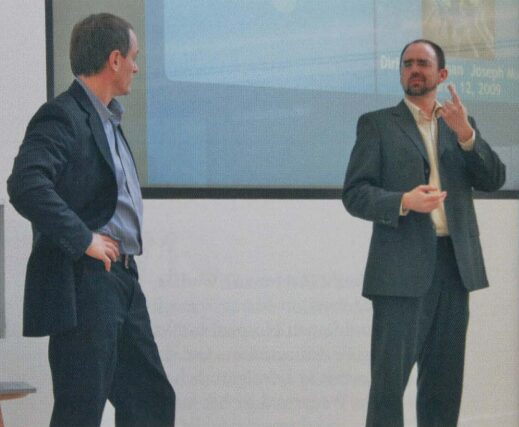
Williamson’s question inspired Bauman and Murray to apply an academic lens to the topic. They first shared their unified theory of Deaf Gain during a 2009 presentation at Gallaudet. The concept was refined for their 2010 paper, “Deaf Studies in the 21st Century: ‘Deaf-gain’ and the Future of Human Diversity”, published in The Oxford Handbook of Deaf Studies, Language, and Education. The presentation and paper were so well-received that the two authors decided to continue their partnership with the seminal book, Deaf Gain: Raising the Stakes for Human Diversity.
“After the presentation, we quickly realized how important the concept of Deaf Gain was to the community. It caught fire,” Murray remembers. “Deaf Gain provided a conceptual framework for research already being done.”
Bauman and Murray define Deaf Gain as “the unique cognitive, creative, and cultural gains manifested through deaf ways of being in the world.” In the book, a variety of deaf and hard of hearing authors make the case for Deaf Gain over 27 scholarly essays. The essays are grouped into different categories of gains: philosophical, language, sensory, social, and creative. The authors build their cases using both philosophical reasoning and research data.
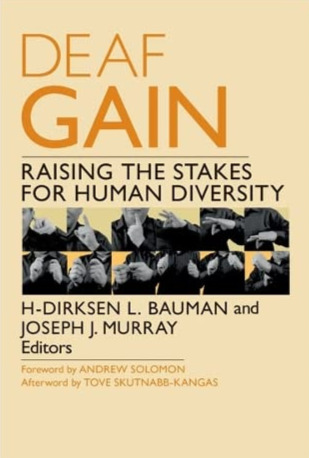
Deaf Gain challenges society’s definition of “normal.” Bauman and Murray argue that the uniqueness of deaf and hard of hearing people makes the world a better place.
“When we look through the lens of biocultural diversity rather than normalcy,” they write, “we are better able to move beyond the single story of deficit to the many stories of complex cause and effect. In this reckoning, what could be considered a pathological condition—deafness—could instead be seen as a contributor to a more robust social and cultural ecology.”
“The whole point was to shift the meaning of ‘deaf,’” Bauman says. “Before Deaf Gain, the deaf way of being was defined by what it’s not. We wanted to change that.”
They succeeded. Deaf Gain immediately made waves in the deaf and hard of hearing community and continued spreading to popular culture. In 2011, millions of viewers were exposed to the concept when Marlee Matlin played a teacher explaining Deaf Gain to students on the show Switched at Birth. Today, a Google search for “deaf gain” gives over 50 million results.
While both Bauman and Murray are heartened to see Deaf Gain spread so widely, they hope it is recognized as a framework rooted in research and science. The benefits of being deaf aren’t just heartfelt anecdotes. They’re backed up by rigorous scholarship.
And Deaf Gain isn’t limited to the ASL-using Deaf community. Hard of hearing, late-deafened, and deafblind people experience Deaf Gain, as well. “Deaf Gain isn’t just about identity,” Murray says. “It’s about a way of being in the world.”
A worldwide impact
Murray has seen the global impact of Deaf Gain firsthand as the President of the World Federation of the Deaf (WFD). He and his team travel to countries all over the world to advocate for the human rights of deaf and hard of hearing people.
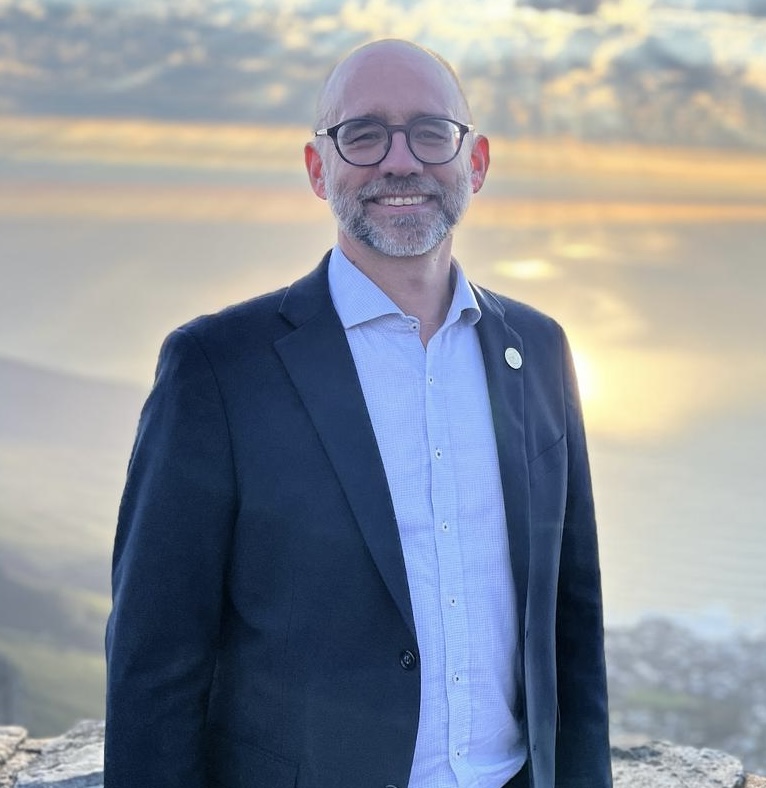
“The idea of Deaf Gain has been used in campaigns to change laws and policies around the world,” Murray says. “I’ve lost count of how many countries have presented to their constituents about Deaf Gain.”
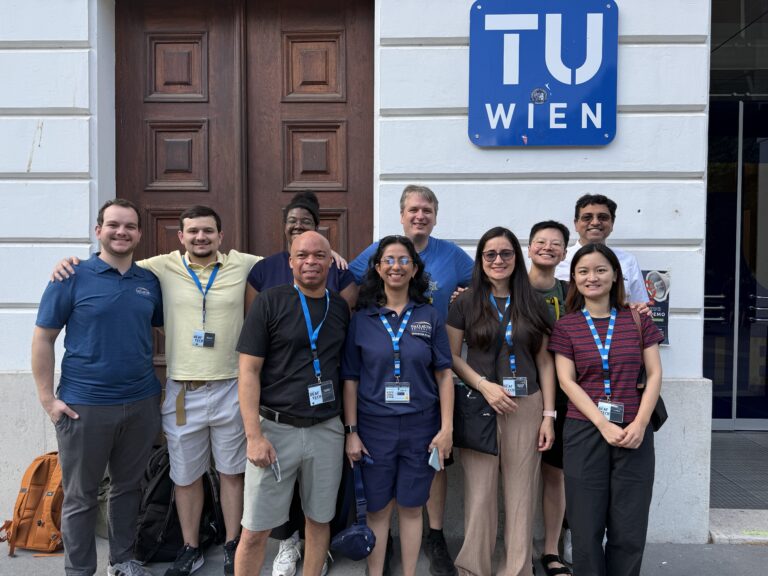
Deaf Gain is a natural concept for Murray. He grew up in a deaf family that was heavily involved in the local community. In 1995, he attended the first WFD Youth Camp in Zell am See, Austria. After serving two terms as President of the organization’s Youth Section, he became a board member. In 2019, he was elected WFD President and is now serving his second term.
Murray is also a Professor of Deaf Studies at Gallaudet. He coordinates the online Deaf Studies B.A. track, which is the largest online B.A. program at Gallaudet.
Befitting his role serving the international deaf community, Murray has lived in several countries over the years. He has two young adult children who are reaping the benefits of Deaf Gain. They were raised multilingually, using ASL, Norwegian Sign Language (NTS), Swiss-German Sign Language (SDGS), German, Norwegian, and English.
Reframing hearing loss
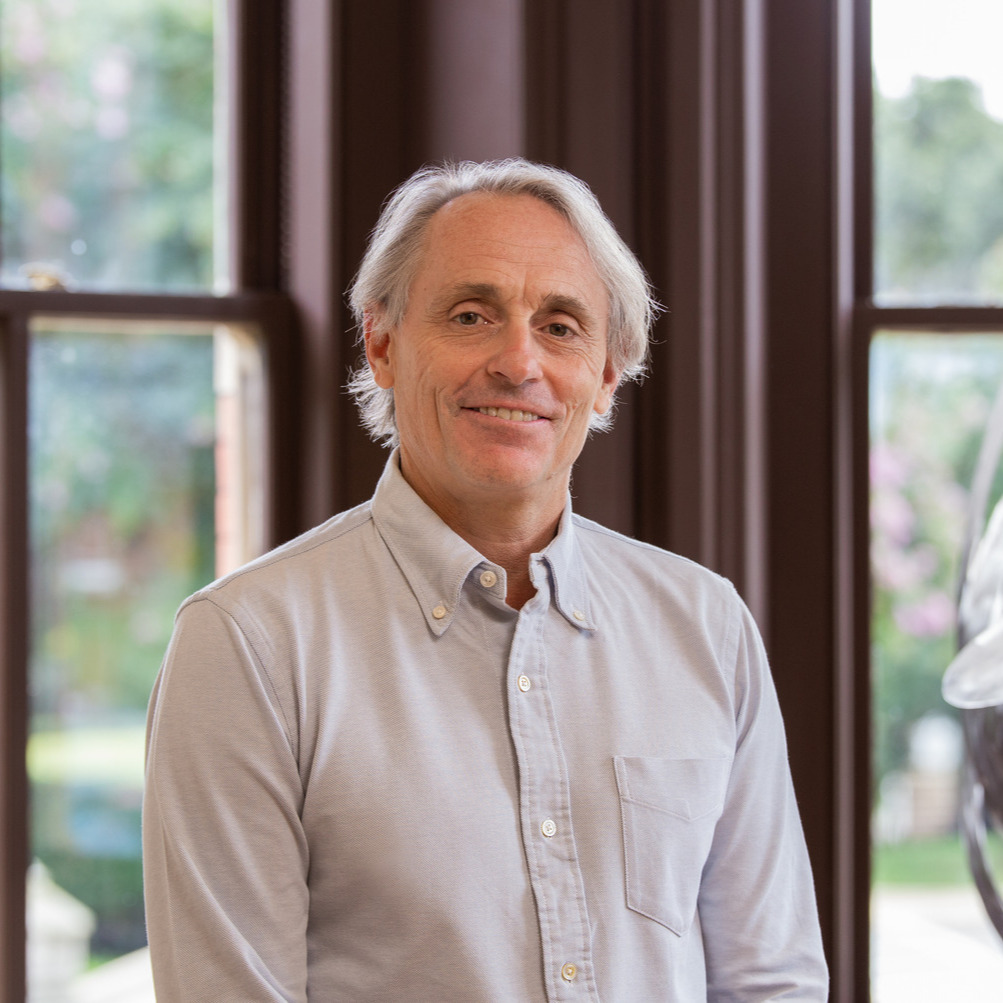
Deaf Gain has a particular meaning for Bauman. He didn’t identify as a hearing person until working at Colorado School for the Deaf and Blind after college. He was often the only person in the room who wasn’t deaf. It changed how he saw the world. He immersed himself in the deaf community.
The experience inspired Bauman to reframe the clinical definition of “hearing loss,” using it instead to refer to the “limitations that hearing individuals experience by not being aware of Deaf ways of being in the world.” Hearing people who don’t use sign language, for example, have no access to the singular beauty of deaf poetry and performance.
Bauman is now the Director of Gallaudet’s Deaf Studies graduate program. Students in the program are required to take a course that covers the foundations of Deaf Gain. While many of them are proud deaf community members, they are still surprised to learn Deaf Gain is backed by academic scholarship.
Expanding Deaf Gain
Many of the contributing authors in Deaf Gain: Raising the Stakes for Human Diversity were Gallaudet alumni and faculty members. In the years since, Gallaudet scholars have continued to explore Deaf Gain.
“Gallaudet is a space where we have the breathing room to explore different ways of being deaf,” Murray says. “The university is also an example of Deaf Gain to larger society. We have a responsibility to model access and bilingual education.”
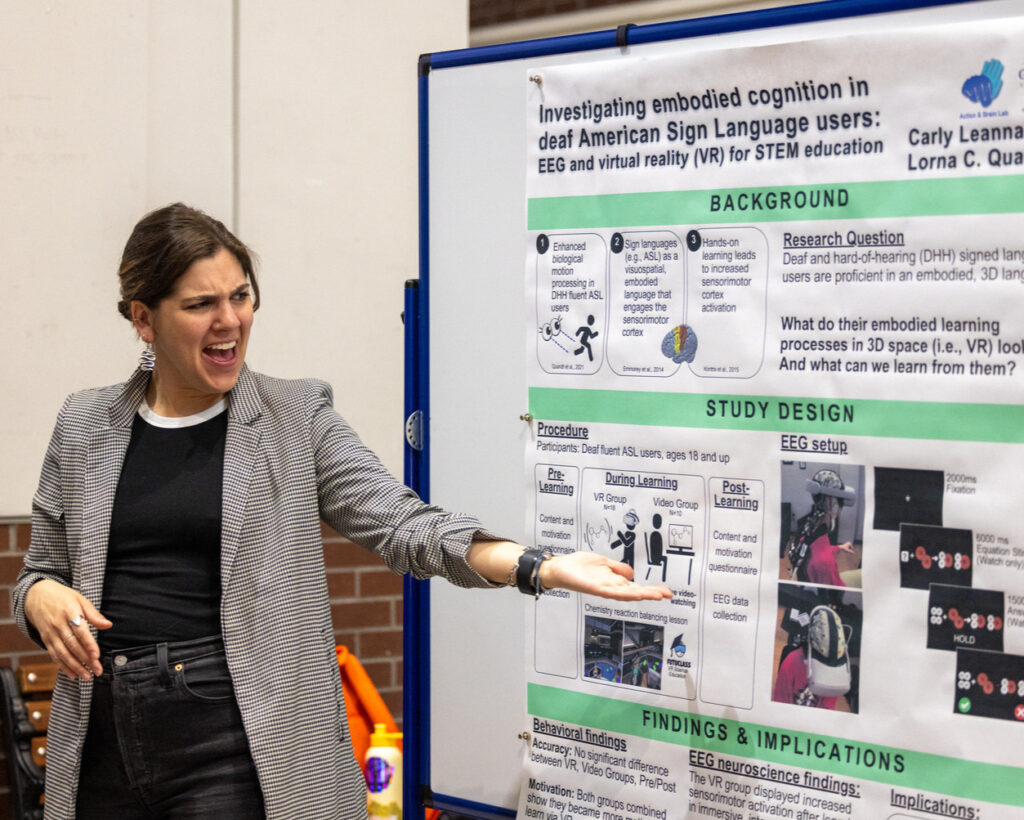
Gallaudet’s Science of Learning Center on Visual Language and Visual Learning (VL2) has used neuroscience to show the unique abilities of deaf people. In 2020, for example, VL2 published a paper showing that deaf people are especially skilled at conceptualizing and moving mental images. A 2021 paper showed that deaf people can recognize motion better than hearing people.
Deaf Gain is also being explored outside of Gallaudet. In 2020, Dr. Rezenet Moges-Riedel of California State University authored “‘From White Deaf People’s Adversity to Black Deaf Gain’: A proposal for a new lens of black deaf educational history”. In the paper, Moges-Riedel uses the Deaf Gain lens to assess how the Black Deaf community has persisted through systemic oppression.
Other scholars have explored Deaf Gain in the classroom and healthcare. Deaf Gain has also made its way into more general disability justice frameworks. The term “Disability Gain” has gained traction amongst disability scholars in recent years, who give credit to the work of Bauman and Murray.
“There have been many new developments, research, and narratives,” Murray says. “The community has taken Deaf Gain and applied it to their own identities. A second book would have many new ideas!”
Bauman agrees. “I want to see the concept of Deaf Gain applied to academic, institutional, and medical fields. How does dismantling traditional systems of education benefit deaf children? How does Deaf Gain show up in other countries? There’s a lot more to explore.”

The future of Deaf Gain
The deaf and hard of hearing community is facing a turning point. Today, many deaf children are given cochlear implants at a young age and steered away from sign language. Several deaf institutes and programs across the United States have been closed. And in the near future, advances in gene editing may allow people to alter their DNA and “cure” their deafness.
These challenges have made Deaf Gain more important than ever. The concept is a vital advocacy tool that can serve as evidence for what deaf and hard of hearing people have known all along: their lives, communities, and cultures make the world a better place.
“The medical and educational systems still define ‘deaf’ as unhealthy,” Bauman notes. “We need to continue shifting mindsets inside the system. Deaf children, and all children, should be taught about Deaf Gain from a young age.”
“Deaf Gain allows us to go beyond a defensive posture,” says Murray. “Sign languages are a net gain for everyone. Deaf people are a part of this world. And so is Deaf Gain.”
Gallaudet is the world’s leading training ground for deaf and hard of hearing scholars. Learn more about our Deaf Studies program, which offers bachelor’s, master’s, and minor degree tracks.