
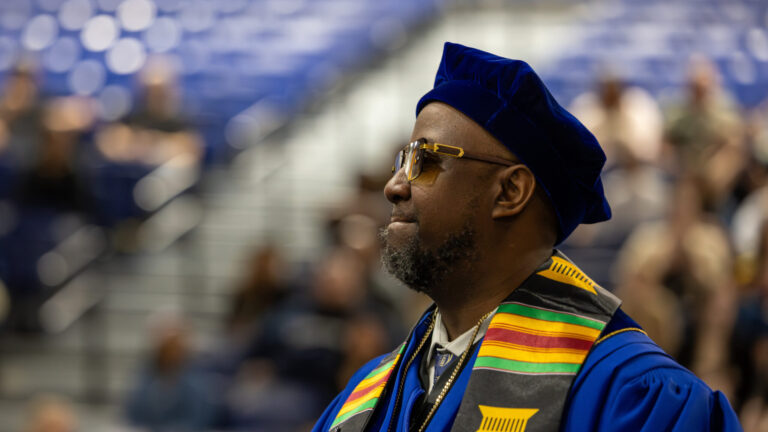

Discover our campus' fascinating past and the exciting future we have in store.
Hanging in the balance between our campus’ roots and our vision for the future, the Campus Design and Planning is responsible for maintaining our historic campus while developing concepts capable of meeting the needs of our growing university.
We owe it all to Fredrick Law Olmsted–the designer behind New York City’s Central Park and the U.S. Capitol’s western terrace–who in 1866 designed our beautiful campus. Now a National Historic Landmark District, our campus covers 99 acres of land and 2.5 million square feet of academic, residential, and support buildings, including the Laurent Clerc National Deaf Education Center–All in the heart of Washington, D.C.
Ongoing Campus Revitalization
In 2013, the District of Columbia’s Zoning Commission approved the Gallaudet University 2022 Campus Plan, the University’s vision for campus development for 2012 to 2022
Funding: Total revenues and other support for FY2021 were approximately $195.9 million
Endowment: As of the end of FY2021, the University’s endowment was approximately $239.9 million
Community Impact: Gallaudet is one of the area’s largest businesses, with direct salaries, wages, and benefits totaling more than $116.4 million in FY2021
The University spent another $89 million on goods and services and $17.2 million on capital improvements.
Since 2012, Gallaudet has constructed two new residence halls and renovated 14 buildings.
DeafSpace
Transcript for How architecture changes for the Deaf Video
[Video Start]
[Video presented in English]
[Sound of subway announcements]
We live in a world built for people who hear.
Hello? Can you hear me?
[Sounds of many different day-to-day activities]
But what would our man-made world look like if it were designed for those who don't hear?
Gallaudet University in Washington, DC is a school for the Deaf and hard of hearing
And they are redesigning entire buildings based on the sensory experience of those who don't hear.
We've only just begun to challenge ourselves to examine how we could design entire buildings, entire campuses, or even cities, to be aligned with DeafSpace.
Deaf people as a culture have been marginalized largely
We've been, as a marginalized community, developing our own culture and that defines what kind of place we call home, how we claim and occupy space.
And so we've begun to ask ourselves these questions and because of that have gotten a lot more creative and think bigger about how we can find different ways to align our ways of being to our environments.
The classrooms are oriented in a semi-circle or U-shape so that classmates and continuously visually connect with other classmates.
So if you want to be involved in a discussion, everyone has a front row seat to seeing.
In a wider hallway, two people can walk in parallel signing with each other.
But we do have specific distance parameters wherein we can observe the whole body and its signing.
Hearing people, though could disregard that kind of a distance requirement they can be just next to each other speaking to each other without that need for the visual field.
Stairs also require more visual attention to your footing and so ramps reduce that.
So if you are communicating with someone while navigating a ramp you can do so much more easily.
Within DeafSpace we have always relied on a heavily visible environment because we are not getting information auditorily.
So if you are sitting at the top of terrace you can see all the way to the bottom of the terrace.
It's one distinct place that can be unified or have three distinct areas.
Color and lighting are highly aligned to communication access.
Blues and greens will usually contrast with most skin tones enough to reduce eye strain you may want to have more diffused lighting.
A lot of the lighting here is directional so that it can be aligned.
There are mirrors present to allow somebody to know and have a sense of what's happening behind them.
Through the use of that reflection they can know if someone is nearing behind them or if somebody taps them.
They can look up and that reflective space lets them know who's there.
Transparency of, say, doorways.
So that when a person is in an office they can either have a transparent doorway or passageway or one that is opaqued.
So that I can see lighting and shadow and movement and know somebody is at the door but not clearly see who's there.
Very often, people refer to "hearing loss" as an example which negatively frames the whole approach from the outset.
But let's imagine the Deaf baby who has never heard and yet is still described as experiencing "hearing loss".
And instead we propose a different framing: that of "Deaf gain"
What is it that we gain by the experience of being or becoming Deaf?
DeafSpace, I believe is born of the idea that we have something to offer the world that being Deaf confers some very interesting perspectives on life.
[Video End]
DeafSpace at Gallaudet
A few ways we’ve been able to incorporate DeafSpace design into our campus:
Group Space
Walkways
Visual Range
Group Space
Walkways
Visual Range
Color and Light
Reflection
Transparency
Color and Light
Reflection
Transparency
The Signing Ecosystem
Discover the new and innovative ways we’re expanding the Signing Ecosystem.
Footer Content
At a Glance
Our Community
Visit Gallaudet
Engage Today



Copyright © 2026 Gallaudet University. All rights reserved.
800 Florida Avenue NE, Washington, D.C. 20002