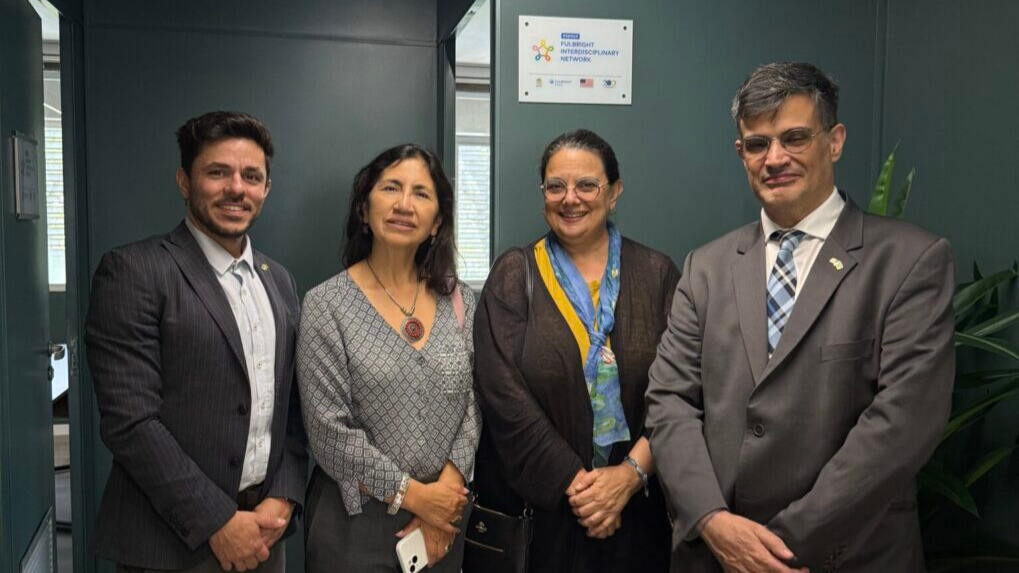
Dr. Teresa Blankmeyer Burke is spending the fall semester in Florianópolis, a city in southern Brazil, to study the ethics of gene therapy and the use of AI in sign language interpreting. Her project — which looks at the impact of these two technologies on signing deaf communities — is funded by a Fulbright Distinguished Scholar award in Medical Sciences from Fulbright Brazil.
Burke is the second deaf person and first tenured faculty member from Gallaudet to receive what is considered the most prestigious appointment in the Fulbright program, the Distinguished Scholar Award. The first Deaf recipient was Dr. Madan Vasishta, ’71 G-’73, PhD ’83, & H ’24 in 2015.
We checked in with Blankmeyer Burke to learn about the origins of her research and what she has learned so far.
Can you tell us about your project?
In my grant proposal, I framed these two very different aspects of technology as providing potential for deaf flourishing (AI automated interpreting could be liberatory in opening up access, but there are a lot of caveats about whether this will actually be feasible, reliable and accurate), and potential for deaf eradication (gene therapy and other forms of gene editing could be a tool used to eliminate many deaf genes).
What led you to conduct your research in Brazil?
Brazil is a huge country with incredible diversity; it is also a country that, like the USA, was founded on colonialist power that exploited indigenous and enslaved peoples from Africa in order to create an empire. There is also a history of centuries of immigration of people coming to Brazil for the opportunity to have a better life (including some members of my own family from Lebanon about a hundred years ago). These broad brush similarities to the USA, combined with all of the particular details that make Brazil a unique place, are also part of what drew me to propose my Fulbright project in Brazil.
You are a philosopher. How do you carry out philosophical research? What does that look like?
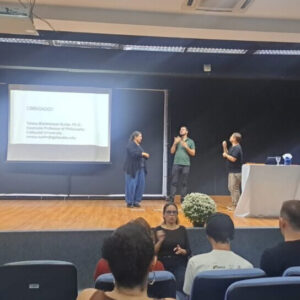
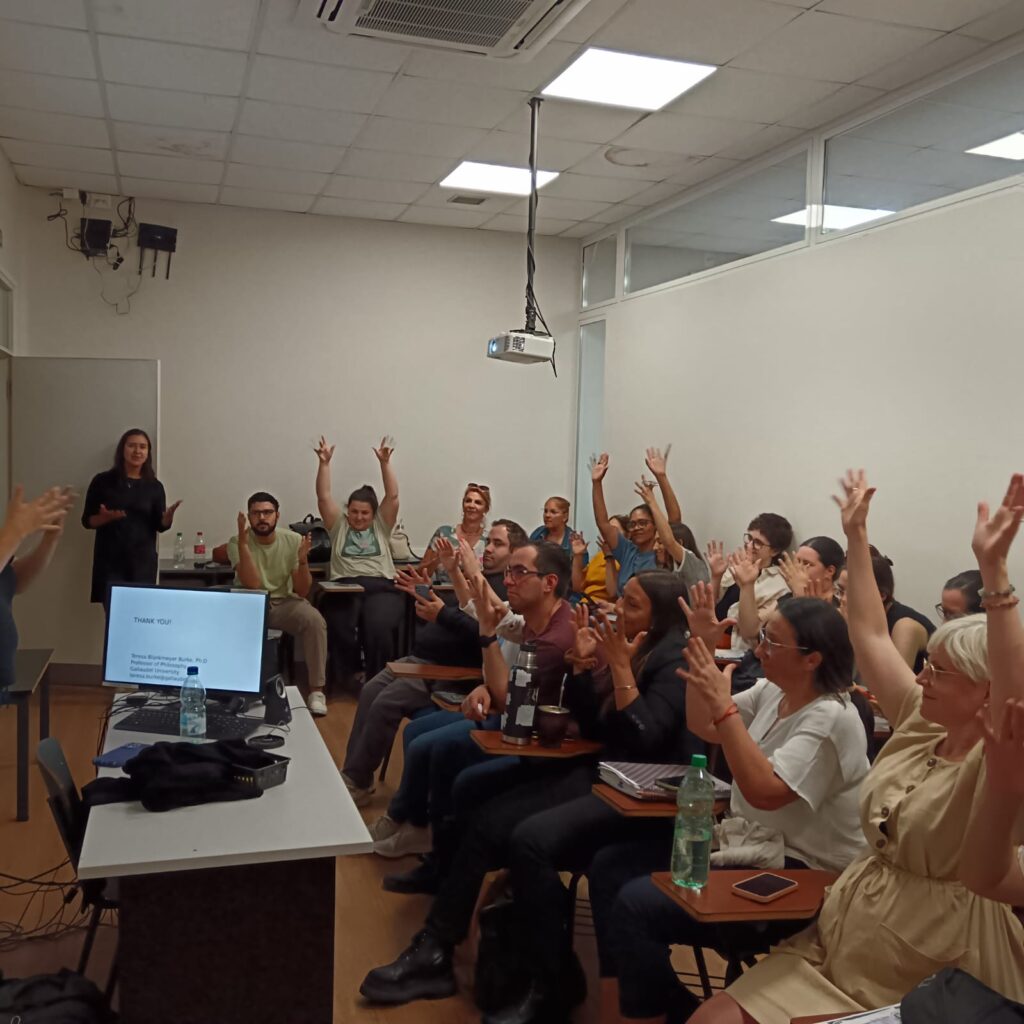
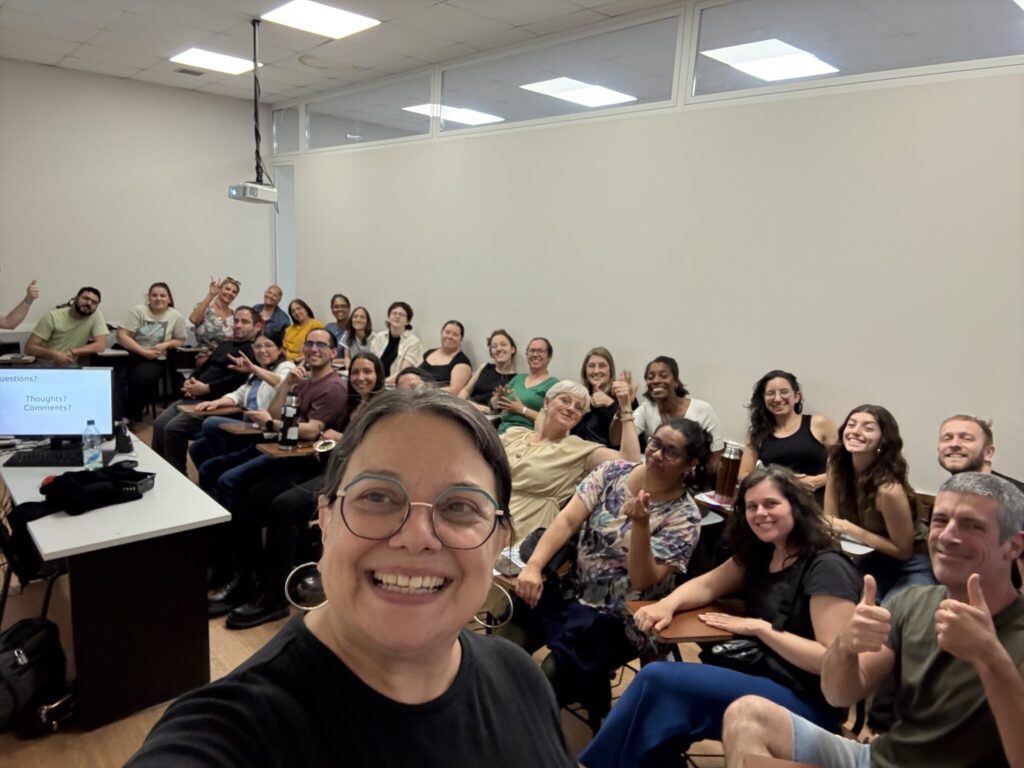
I am having philosophical conversations with Deaf Brazilians about the ethics of genetic technology and AI technology. But what gets misunderstood by many people is the nature of what it is to have philosophical conversations.
Academic philosophical training gives me certain tools for asking questions that reach deep into the philosophical subfields of ethics, epistemology, metaphysics, and of course, logic, which is the foundation for philosophical argument. Having that theoretical foundation is what I bring to the philosophical conversations I have within the signing Deaf community – including now in Brazil.
One of the hallmarks of academic philosophical writing is that we are expected to cite our conversations and credit our conversational partners with questions and ideas that they bring to our attention. These can appear in our acknowledgement sections as well as our footnotes or in the introduction/preface of monographs. This can be tricky, since often academic circles are small, and different circles have different levels of power and prestige. The academics with philosophical cachet tend to be philosophers; this is a distinct group from Deaf academics, who I also engage in conversation and acknowledge. Since I work across the fields of bioethics, philosophy and deaf studies, it is important that I have philosophical conversations with scholars affiliated with each of these fields. In my next few publications you can expect to see a lot of Brazilian academics in my acknowledgement sections!
How are you handling the language barrier?
I started studying Brazilian Portuguese on Duolingo during the hectic early months of the pandemic as something that could pull me away from the horrors of doing Deaf and disability bioethics under audist and ableist pandemic policies that were written prior to Covid; such policies definitely resulted in inequities for Deaf and disabled people, including loss of life. One of my earliest publications on deaf bioethics was translated into Brazilian Portuguese, and since that time, I have kept an eye on Brazilian bioethics and deaf studies. Once I had exhausted Duolingo, I began to take courses in written Portuguese and later hired tutors to help me continue to learn the language.
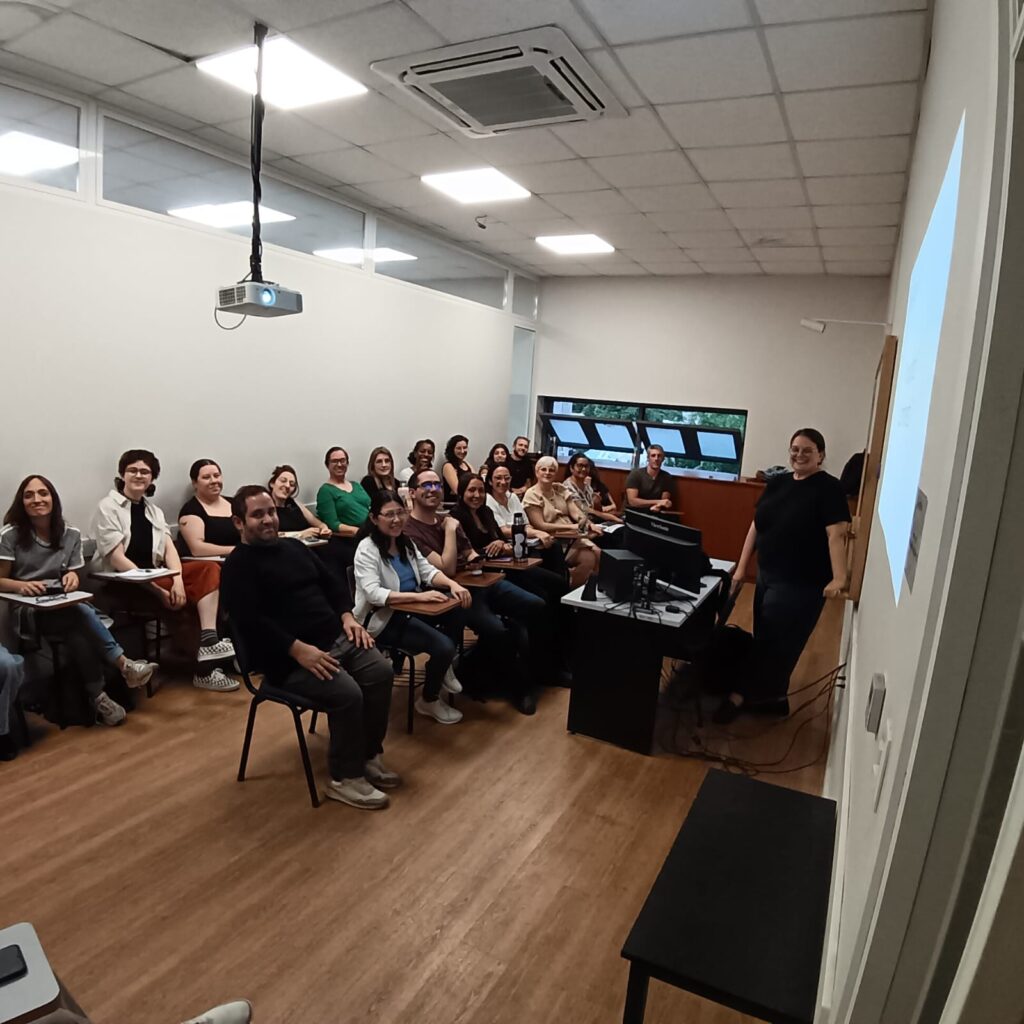
Many of the conversations I am having are interpreted ASL/Libras, since I am learning Libras (Brazilian Sign Language) but my ability is conversational and not yet sophisticated enough to have these deep philosophical conversations. Fortunately, at the Universidade Federal de Santa Catarina in Florianopolis, there are several people who are fluent in Libras and ASL. I have also found in my Libras/international sign conversations that my five years of studying written Portuguese has been helpful for fingerspelling, mouthing, and translating concepts across Libras that don’t work as well in ASL or English.
Do you have any particular hopes about the work you are engaged in?
I have a few hopes about the public-facing side of my work, which is to provide sufficient background and context for Deaf Brazilians – including Deaf academics, policy makers and leaders of advocacy organizations — to acquire a robust sense of the potential implications of gene therapy on the signing deaf community and to translate this understanding into wider dialogue within the signing Deaf community about how to respond to this new development, especially with regard to the OTOF (otoferlin) gene therapy that was widely reported on in 2024.
Brazil has a history of strong policy making that supports the signing Deaf community, most notably in educational policy, including interpreting access. I recently sat in on a discussion that reviewed a draft for a policy proposal recognizing linguistic violence and the harms that linguistic violence foists on Deaf people. I am keenly aware that cultural history and context shape policy responses, and while it is true Deaf people everywhere share certain experiences, it is also true that the particular ethics, cultural values, economic resources, political institutions, organization of social systems and community dynamics will be unique to each deaf community. I see my role as providing a philosophical lens and analysis on an issue that has global implications for the signing Deaf community – and yet, I am very clear that the perspective I bring to these conversations I am having with Deaf Brazilians is shaped by my experience as a U.S. American who came of age in California pre-IDEA and pre-ADA.
Can you share any practical lessons learned so far?
While it might seem a little unusual for a philosopher-bioethicist to be housed in a program that is not a Philosophy Department or a Medical School, but instead a department that is language and culture focused, one of the things I learned during my first sabbatical was that I could spend time conducting research or time building the infrastructure to get access. I did not want to spend my precious sabbatical time on developing infrastructure and teaching philosophers and medical school faculty about their legal obligations under the law, and so I quickly determined that having an affiliation with the part of the university that did understand the experiences of deaf academics was a prudent approach that preserved my time for what was important to my goals.
You’re also working on developing Gallaudet’s global connections through your Fulbright. Can you tell us more?
One of the big goals I have for my visit is to build a network of Deaf academics in Brazil and Uruguay, with the aim of developing COIL courses and other partnerships with Gallaudet University. I’ve started talking with deaf academics in Brazil about the resources provided by the Brazilian government to support Brazilian PhD students and post-docs wanting to further their education abroad, and I have also talked with some of the highly successful senior, mid-career, early career Deaf Brazilian academics about their experience decades ago with a joint Gallaudet University-Brazilian government project.
These are challenging times for higher education around the world, but we cannot let that stop us from building bridges to countries in Latin America – the potential for intercollegiate exchange offers rich opportunities for all our students to be well-educated global citizens who can make a difference in the lives of Deaf people everywhere.
What do you get up to during your free time?
During this time, I also get two weeks of vacation, which I am spending with family. I visited Santiago, Chile in late October as a birthday present to myself, and met over 130 cousins! While there, I had several conversations about deaf bioethics with family members working as doctors, lawyers, writers, and interpreters. That was a fun and unexpected bonus to my trip, and I’m already planning a return visit to Chile in hopes of connecting with the Deaf community.
Blankmeyer Burke’s project is sponsored by Dr. Ronice Muller de Quaddros, linguistics professor and CODA (Child of Deaf Adults), at the Universidade Federal de Santa Catarina (UFSC). She thanks several Deaf professors who have been supporting her, including Mariana Stumpf, Carol Ferreira Pego, and Andre Riberto Rivera.