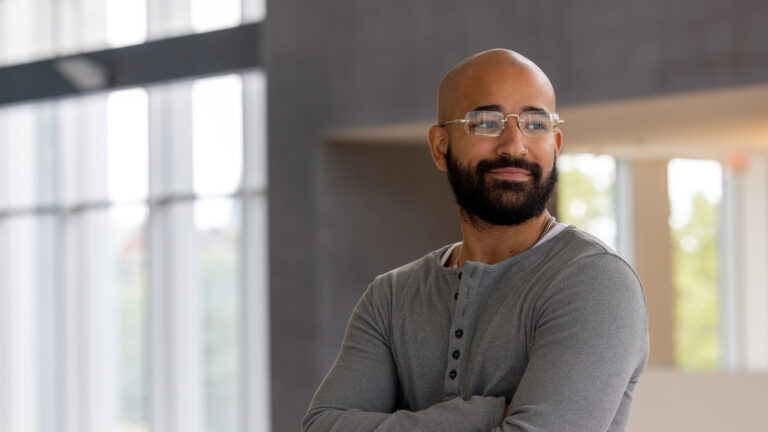
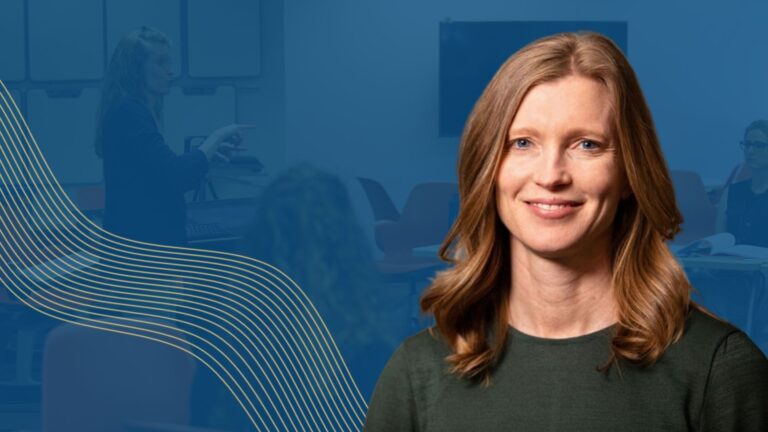
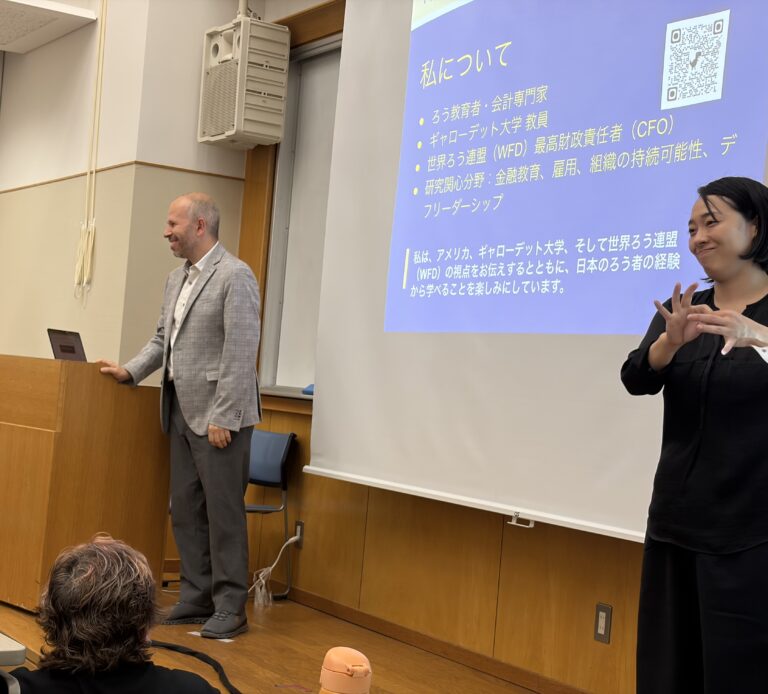


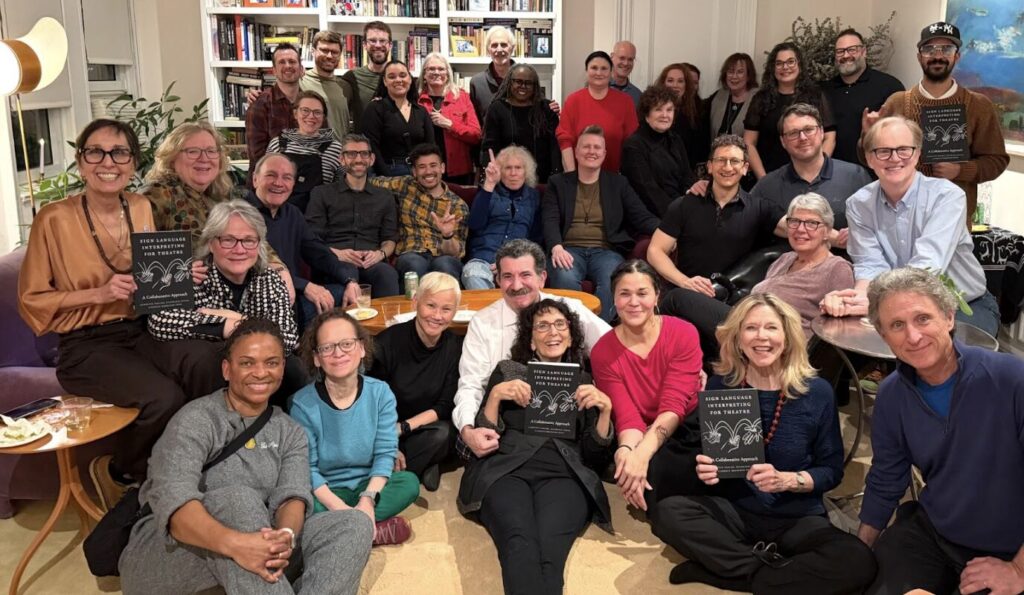
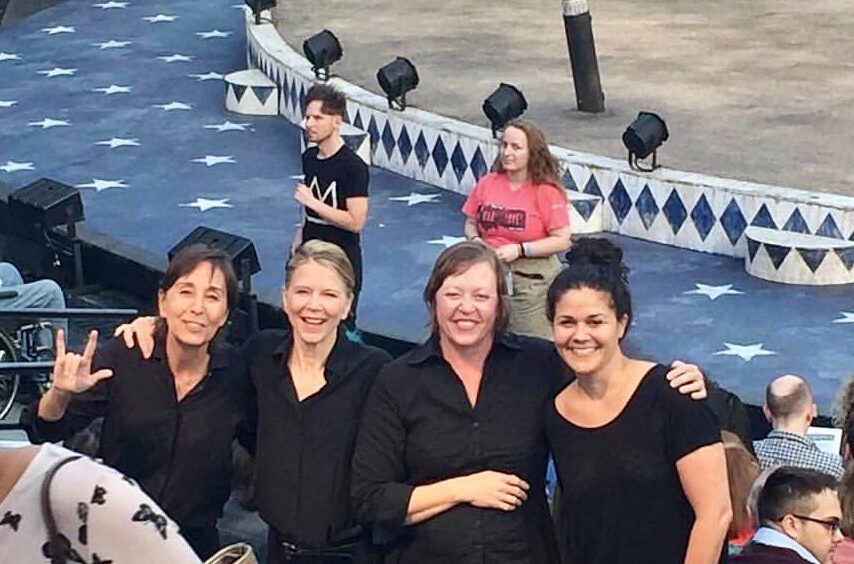
Gallaudet University Press recently published Sign Language Interpreting for Theatre: A Collaborative Approach, by three veteran theatre interpreters working in New York City: Lynnette Taylor, Stephanie Feyne, and Candace Broecker Penn. A first-of-its-kind resource, the book draws on the trio’s combined and collaborative experiences to weave together history, theory, and practice.
Each author has a unique connection to Gallaudet. Feyne and Broecker Penn interpreted into International Sign (IS) for Deaf Way I & II, and Feyne was a presenter at the First International Symposium on Signed Language Interpretation and Translation Research. Taylor’s mom, Velda (Betty) Taylor, ’48, was a proud Gallaudet alum who also taught art at the Kentucky School for the Deaf. Broecker Penn’s parents are Clarence W. Broecker, Jr., ’51, and Elizabeth “Betty” Broecker, ’68, who met at Gallaudet. She has many warm memories of Gallaudet, including watching shows she saw in Elstad, such as “The Threepenny Opera” with Linda Bove, ’68, Ed Waterstreet, ’68, and Phyllis Frelich, ’67, and seeing “Gianni Schicchi” performed by the National Theatre of the Deaf (NTD). Here, the authors give us a peek into their new book.
Q: What is the backstory of this book?
Taylor: The roots of interpreting in the theatre began because we wanted to share theatre experiences with our friends and family. It began as friendterping, where we sat side by side in the audience, co-creating an impromptu interpretation of the play. It was dynamic, it was relational, and it was fun! This collaborative experience of interpretation informed our approach to the work. We invite readers to think about how this practice can capitalize on the ways in which it can support Deaf creatives and Deaf audiences to be an integral part of the theatre arts community.
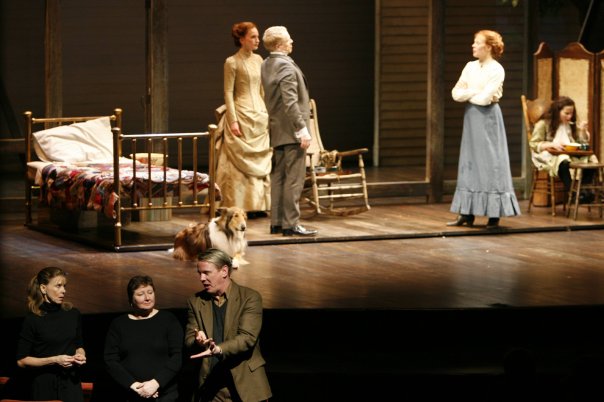
Broecker Penn: For twelve years, the three of us, along with Alan Champion, taught the weeklong seminar Interpreting for Theatre through the Theatre Development Fund and the Juilliard School. After Alan’s passing in 2011, we began to write initially to honor our shared work and to document the training we had developed together. This book became our way of capturing the ideas, questions, strategies, and considerations that emerged from decades of collaborative practice. More than anything, we hope it sparks ongoing conversations among interpreters, audiences, and theatres that will continue to advance the practice of interpreted theatre.
Q: How would you compare interpreting theatre to interpreting a meeting, lecture, appointment, or other community assignment?
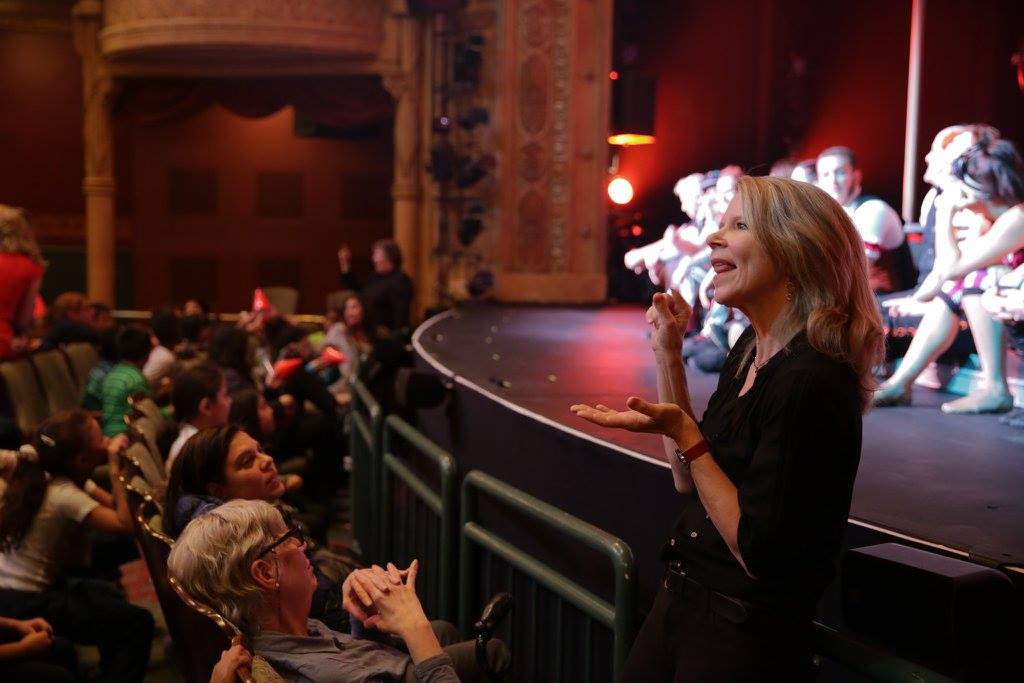
Feyne: There are a great many differences. Two major ones are the fact that in community assignments, 99% of the time, the Deaf participants share the contextual knowledge – they know why they’re at the doctor’s office, their child’s grade at the parent-teacher meeting, and the topic they are presenting on at the conference. In fact, it is the interpreter who is often playing catch-up. Whereas in theatre, the interpreting team has the contextual knowledge. They have seen and rehearsed the play and the audience members are often coming in cold – not knowing context, players, history, even names or era. In this case, the interpreting team is responsible for creating a linguistic link to the story being told onstage, more so than would occur in a community setting. In addition, this interpretation is interactive and dialogic. And yet, what is similar is that we are still responsive to the audience and can still incorporate spontaneous communication, such as audience responses, to the stage.
Taylor: I mean, it was the bard himself who said, “All the world’s a stage…”
We had so many participants in the Juillard Interpreting for the Theatre seminar who later told us how much it changed their approach to interpreting. Many said it helped them see everything as a kind of story, even the lecture on neuroplasticity. They began to see that many of our daily interactions were just like that of a play – there were monologues, dialogues, meaningful silences, characters – each with their own motivations. This, in turn, helped them look for the narrative thread in interactions, in lectures, and the like.
Q: In your book, you say interpreting theatre sparks powerful and positive experiences. Can you expand on that or give an example?
Broecker Penn: On Broadway, “The Picture of Dorian Gray” was a solo performance with Sarah Snook portraying 26 characters. The challenge for me was to interpret the straight two-hour show alone as well. I worked with two Directors, Anne Tomasetti and Kailyn Aaron-Lozano, both Gallaudet alums. I felt like I was in a master class as they shared their knowledge of literature and understanding of drama, and guided me with the challenges of presenting split-second character depictions, finding moments to squeeze in focus to the stage, and helping me navigate the challenges of simultaneity and performability while interpreting an incredibly wordy play. We had great discussions in ASL about the adaptation, the meaning of the story, the characters, the lines, and the staged production. Having dedicated time with my colleagues for this creative process and being immersed in the world of the play to design an interpreted performance is an experience I will always value, both as an artist and as an interpreter.
Taylor: The worlds that open through narrative and through the exploration of narrative, forever change me, and the gift of being able to enter these worlds through translation, through my native tongue, leaves a lasting impression on my heart and mind. To be able to share this with a community, with an audience, to see these spaces that were, when I was growing up, places I could not go to with my Deaf family or friends, and now not only are they here in the audiences, but also on these stages. It is so uplifting to know that with community, things can change.
Q: Why do you advocate for a collective approach in theatre interpreting?
Broecker Penn: Theatre is created by many artists, each making choices designed to build a shared world on stage. Directors, designers, and actors rehearse and refine those choices so the audience experiences something cohesive and intentional. That finished production is our real source material; the script is just one of the tools we use. Our fidelity is to the production on the stage.
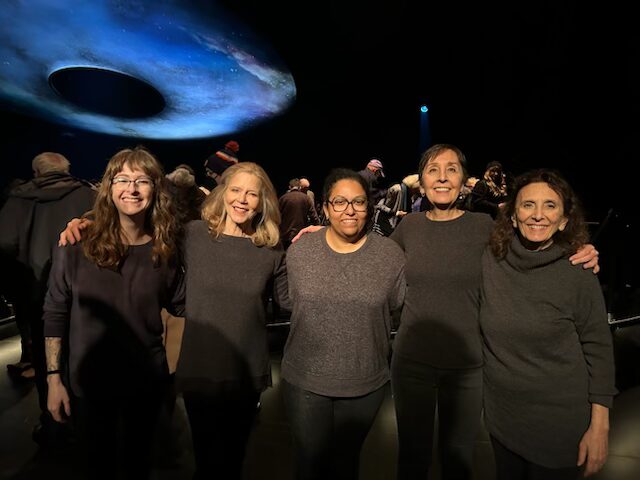
Similar to the process of creating theatre, theatre interpreting really benefits from a collective, interactional approach. When interpreters work as a team, we can unpack meaning in all its layers: directorial choices, blocking, lighting, sound, visual elements, costumes, actors’ physicality and line readings, character relationships, and meanings found in the story. When the team shares this deeper understanding of the production, we can make aligned decisions that support one another. Those collective choices help us create an interpretation that complements the world on stage and hopefully deepens the audience’s connection to it.
Q: Teaming relationships are central to this work. What are the qualities you appreciate most in a team?
Taylor: When you are with a team that is in it for the process as much as the product, there is so much more space for discovery!
I love teams that love to explore the boundaries of the translation, take it out there to its outrageous, bodacious self, like a fanning peacock, and then rein it in. I love when the team shares those moments in the play that move them, irk them, challenge them. I love working with those who commit to the work and are fully present, and flexible. Guess what? Life is always a surprise and your teammate may be sick on the night of the show, so you now have to step up to the plate. The beauty in collaborative work is that everyone becomes familiar with the whole story, and you’ve seen your partner’s interpretation and been with them in the process of development, so at least you’re not starting cold.
I deeply appreciate the process of coming to a shared understanding, of developing team agreements. I also know how intimidating this space can be when we are so used to being in a hypercritical environment. Thich Nhat Hanh, a Vietnamese monk, had a great teaching: if you are always looking to see where the other is on their path, you will miss your own. So be where you are in this moment, because truly, we can’t be anywhere else, no matter how much we wish to be. Sometimes a translation won’t come to me until years after a play, because at the time I met it, I wasn’t in a place to understand it. And even though it is late, I am still grateful it came.
Q: Who are your heroes, especially in this area of work?
Taylor: I have so many, both in the past and in the present. Those who have left an enduring imprint on me are those who had the courage to forge new paths, to step into new spaces, to change and challenge constricting norms. One of those is my mother. A Deaf single mother living life as an unwed mother and artist in her time was quite something. She curated a life full of grace and spice. We spent many hours in the kitchen signing poems, the Bernard Bragg, ’52 version of “Tyger, Tyger” was a piece that lived on our hands. We tried to memorize his translation (pre-video) and signed it so many times! Artists who were really expanding the vocabulary of ASL poetry, comedy, art, dance, such as: Linda Bove, ’68, Mary Beth Miller, ’67, Ella Mae Lentz, ’76, Ben Bahan, ’79, Eric Malzkuhn, ’43 and now his granddaughter Melissa Malzkuhn ’04 & G-’08, Sam Supalla, Rita Corey, ’78, Ed Chevy, E-’76 and the Musign company, Alan Barwiolek, ’75, Charlie McKinney, ’65, Sam Edwards, ’65, so many heroes from that era! Continuing the tradition: Alexandria Wailes, Joey Caverly, ’11, Andrew Morrill, ’16, Monique Holt, E-’07, Zavier Sabio, ’05, Anne Tomasetti, ’95, Doug Ridloff, ’99, Lauren Ridloff, H-’22, Kailyn Aaron-Lozano, G-’20 & ’21, Fred Beam, David Rivera, ’00, Manny Hernandez, ’01 & G-’16, and the entire 2026 Superbowl ASL and Puerto Rican Sign Language teamare still my sources of inspiration, many of whom are Gallaudet alums.
Broecker Penn: My heroes begin with my mother, Betty, a strong-minded Deaf woman with a love for the arts and politics. What a gift to be born into her Deaf world and community! Later, I had the joy of working with the NTD as one of their speaking actors, learning from incredible artists such as Bernard Bragg, Linda Bove, ’68, Ed Waterstreet, ’68, Joe Sarpy, Freda Norman, E-’69, Phyllis Frelich, ’67, Rita Corey, ’78, Patrick Graybill, ’63 & G-’64, Carol-lee Aquiline, CJ Jones, H-’21, Carole Addabbo, Tim Scanlon, ’71, Nat Wilson, ’79, Shanny Mow, ’61, Ray Fleming, ’74, Sam Edwards, ’65, and many more. I gained so much from them. During summers, we studied acting, movement, mask, sign mime, or visual vernacular with extraordinary teachers like Lloyd Richards, John Broome, Michael Posnick, and Bernard Bragg. In rehearsals, the company worked collaboratively, and as actors developed their characters, I would create voices to complement their choices. My experience in NTD rehearsing, performing, studying, and travelling as a company helped to shape the approach I bring to interpreting theatre.
Feyne: So many! First and foremost – my co-authors Lynnette and Candace. They are amazing, talented, thoughtful, joyous, and collaborative practitioners, and I am so fortunate to have them as friends, colleagues, and thought partners. I can’t leave out Alan Champion – his work was breathtaking, and the four of us teaching our annual seminar is an experience I will cherish forever. I’ve also been very fortunate to work with talented theatre interpreters and directors of interpreters in NYC and across the country. Too many to name!
Last month in NYC, I went to an interpreted show and the team consisted of friends of mine who are literally half my age. I was struck by how deep their work was. They’ve indeed honed their craft. What is joyful to me is that we have a community that builds from generation to generation and creates exciting interpretations that bring the audience so much pleasure. I guess this means I have a lot of heroes of different ages and backgrounds who dedicate their time and talent to share the art of theatre with the ASL community.
You can purchase Sign Language Interpreting for Theatre: A Collaborative Approach online and check out GUP’s other offerings in its Spring 2026 catalog.