

Raphael Domingo, PhD ’22 is accustomed to being a leader as a co-founder of the Philippine Federation of the Deaf and its youngest president at just 21 years old.
Known as Dx. Rafa, they use gender-neutral professional titles (Dx.) and pronouns in Filipino (siya) and English (they/them). Long before studying at Gallaudet, they had been active for years in the fight for Deaf language, culture, and education in the Philippines.
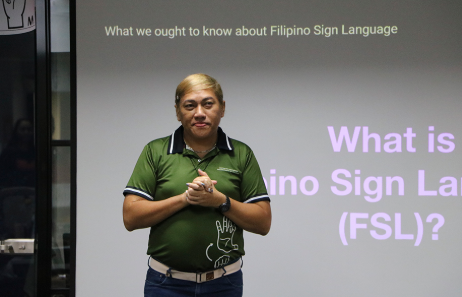
Today, Dx. Rafa leads the Deaf Heritage and Filipino Sign Language Studies unit at De La Salle-College of Saint Benilde’s Center for Education Advancement of the Deaf (CEAD) in Manila. The unit is staffed by a grassroots group of Deaf Filipino researchers who have been trained in linguistics research by Dx. Rafa and visiting scholars over the years. The importance of their Filipino Sign Language (FSL) research has only increased since 2018, when the Filipino Sign Language Act, recognizing FSL as a national language, was passed.
Finding inspiration in academia
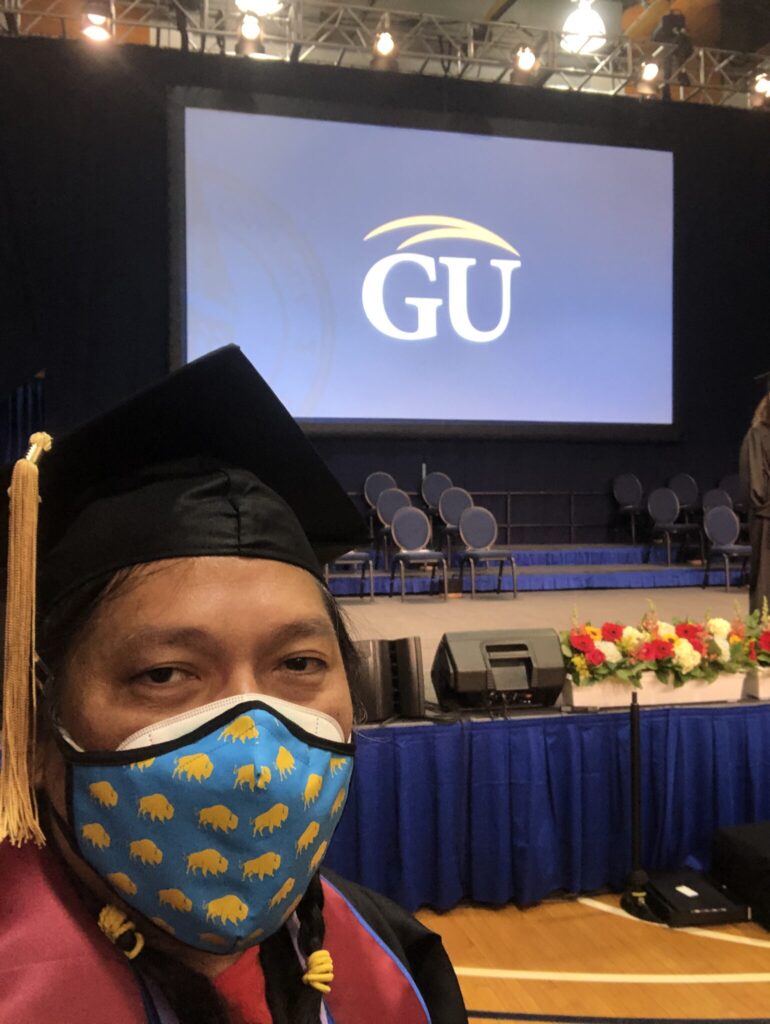
Before joining CEAD, Dx. Rafa spent a year in Japan on a leadership skills training program for disabled people in Asia and Oceania when they were 25. In 2012, they earned their MA in International Affairs from American University through a fellowship from the Nippon Foundation’s Institute on Disability and Public Policy. With a certificate in bookkeeping and a Bachelor in Applied Deaf Studies from De La Salle-College of Saint Benilde, Dx. Rafa’s path would bring them back to their alma mater.
In 2011, Dx. Rafa’s journey in FSL research deepened. They observed that interpreters frequently relied on fingerspelling and used single signs to represent multiple concepts. The absence of precise FSL vocabulary limited students’ conceptual understanding, as demonstrated when a student taking a pilot culinary class approached Dx. Rafa with a problem: he struggled to follow the interpretation when it relied so heavily on fingerspelling.
Building on the student’s suggestion, Dx. Rafa initiated the first FSL research project to develop technical signs in culinary arts. The Benilde culinary experts provided the conceptual foundation, and the first Benilde Deaf FSL research team analyzed key concepts and collaboratively developed contextually appropriate signs, drawing on their own FSL fluency and on Deaf community consultations they organized for the project. This initiative served as the foundation for the Academic Signs and FSL Syntax Research Program, established in 2016. It also inspired Dx. Rafa to pursue further studies in linguistics.
After a third application attempt to Gallaudet’s Nippon Foundation-funded World Deaf Leadership Scholarship, Dx. Rafa’s persistence paid off. This time, they were not only accepted but also funded for a five-year PhD degree in Linguistics (the scholarship typically covers two years) to start in fall 2017.
Initially overwhelmed by academic language and jargon at Gallaudet, they say, “I’m grateful that I didn’t give up. Deaf students definitely struggle with language deprivation; I experienced some of that myself, but I convinced myself to break through.” Dx. Rafa is also grateful to family, their peers from CEAD, and mentors like Linguistics Professor Dr. Miako Villanueva, G-’04 & PhD ‘11, who encouraged them to persevere.
A turning point
Prior to 2018, when the Filipino Sign Language Act was passed, research and publications on FSL had already been undertaken by the Philippine Federation of the Deaf, Inc. and the former Philippine Deaf Resource Center as early as 2001. Earlier studies were conducted in the 1990s by Gallaudet-trained linguists Liza Martinez, G-’95, and Dr. Rosalie Ricasa, G-’92 & PhD ’11.
“In the early 2000s, a turning point emerged for sign language in the Philippines. Then-Philippine Department of Education Secretary, the late Hon. Raul Roco, called for the creation of a National Sign Language Committee, recognizing the need to formally support sign language development alongside Braille initiatives,” explains Dx. Rafa.
Martinez was initially invited to lead the committee, but declined, recommending a Deaf leader take the role. In 2001, Dx. Rafa assumed the chair position, marking a significant shift toward Deaf-led language development and advocacy.
This leadership paved the way for stronger research and documentation efforts. In 2007, the Philippine Federation of the Deaf, Inc. published the Status Report on the Use of Sign Language in the Philippines, covering education, sign language instruction, interpreting, media, and research. The report found that 54% of Deaf respondents identified FSL as their language, an important step toward its broader recognition.
From educational accommodation to research-based advocacy
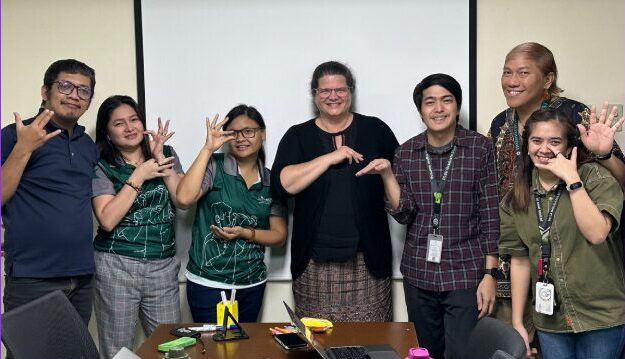
In their first role at the De La Salle-College of Saint Benilde, Dx. Rafa and their four Deaf staff supported inclusion at the institution. Once the need to develop specialized signs became evident through students’ experiences in culinary courses, the RIT-NTID Technical Sign Language Project was added, along with the start of building an FSL corpus, increasing the staff to seven.
Dx. Rafa was instrumental in raising the priority of FSL research at CEAD. Taking what they had learned at Gallaudet, they trained their staff in field methods. “The process was slow and not straightforward, but the value of the work is now recognized,” they say. Encouraged by their teacher, Ricasa, and inspired by the ASL Signbank, Dx. Rafa returned to the Philippines for an internship two years into their doctorate to start an FSL Signbank with their Benilde-CEAD FSL team of sixteen.
Villanueva has worked with Dx. Rafa and the FSL research team on linguistic analyses around constructed action, depicting signs, and indicating verbs for the past two years. She says, “The Filipino Deaf community had to work to document and collect a lot of information and research for the Filipino government, and they have.” She says the subsequent impact is that schools are encouraged to use FSL at the equivalent level of a spoken language.
Not only does the work of Dx. Rafa and their team contribute to bolstering the position of FSL in the Philippines, but Villanueva says the unit also uplifts the Filipino Deaf community. “This kind of linguistic documentation analysis is phenomenal because it’s very community-based,” she says.
Through the Nippon Foundation’s support of CEAD’s Model Learning Institute on Deaf-Centered Education (MLIteDCE) project, the unit’s research capacity has grown. It provides data, tools, and research, from academic sign development and building an FSL Corpus-Signbank, to creating FSL-English bilingual storybooks for students through the Deaf Heritage and Deaf Life Stories (DHFLS) project. The team has also created a set of linguistic manuals, called the FSL Student Handbooks, the original of which served as a capstone project of the first cohort of Benilde Diploma holders on Sign Language Documentation, and who are now the team leaders of DHFLS FSL research projects.
“Now it’s time to do serious advocacy work, using high-quality, Deaf-created FSL materials to make sure schools have those resources, and to work with teachers to improve their FSL skills,” explains Dx. Rafa.
Policy changes from the ground up
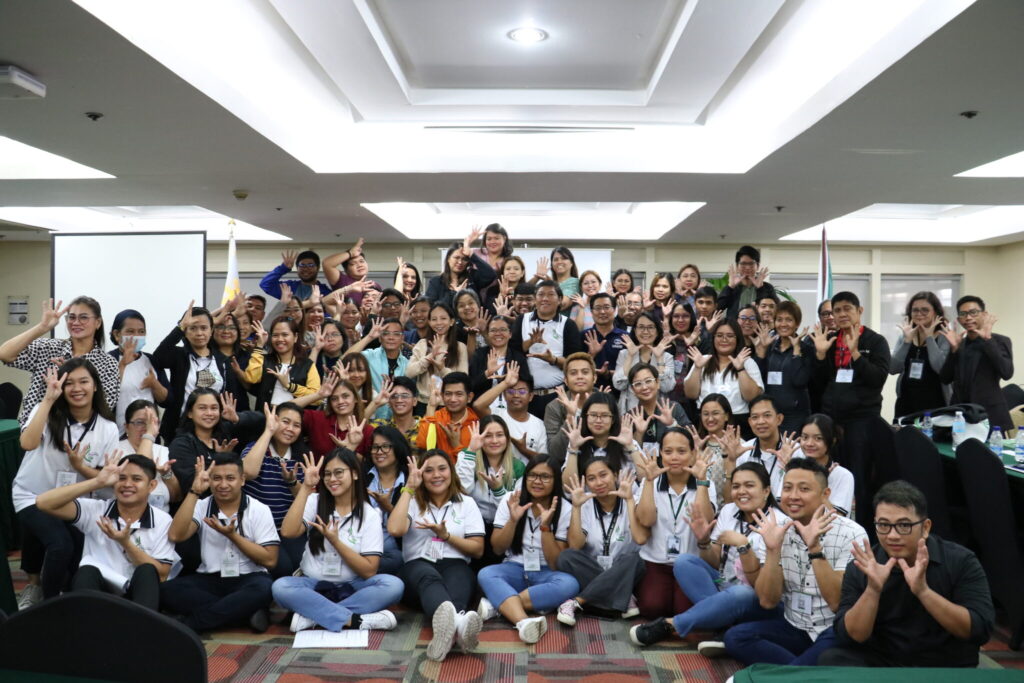
Dx. Rafa’s unit is rooted in the Deaf Filipino community and, through years of relationship-building, also works with the Department of Education – Bureau of Curriculum and Delivery initiative to implement the FSL Law in education. CEAD contributes to making FSL central to Deaf education by developing an FSL Core Curriculum for grades K-12. Another area of collaboration with the government is Dx. Rafa’s representation on the consultative body tasked with ensuring that Deaf students receive appropriate support in inclusive education in the Philippines, as mandated by a 2022 law on inclusive education.
“With some improvement and changes, this law can be positive, especially for Deaf students who may be placed in regular classes in high school, but not in elementary school,” says Dx. Rafa. They will continue to advocate for self-contained Deaf classes to provide young Deaf children with the needed support to develop their first language. “So many children have already experienced language deprivation at home since they’re born into hearing families that don’t know how to sign. They need to gain a strong language foundation first,” they say.
CEAD is working on developing an FSL policy and guidelines to inform the law’s implementation. Now in the drafting process, Dx. Rafa says they also want to see a provision that mandates hiring Deaf teachers in early grades. “It’s important for Deaf children to be exposed to cultural and linguistic models that only Deaf teachers can provide. It will positively impact children’s identity development and confidence by enabling them to see and regularly engage with successful deaf adults. That’s our goal with our work, and that’s my personal motivation, too,” they say.
More than anything, Dx. Rafa wants to see a robust education system for deaf students in the Philippines, starting with schools for the deaf staffed with Deaf teachers who are teaching FSL, and teaching in FSL. “It can be tough, but I have to get the message across that FSL is important,” they say.
Gallaudet offers master’s and doctoral degree tracks in Linguistics. We also have a Linguistics minor for undergraduates. Visit the program page to learn more.