


Overview
The Art + Visual Communication Design major offers three specializations – Animation, Film + Video, and Fine Arts. It is an interdisciplinary program that prepares students to think creatively, communicate visually, and work across artistic and design disciplines. The program integrates studio art, graphic design, digital media, photography, film, animation, and art history to support both conceptual development and technical skill.
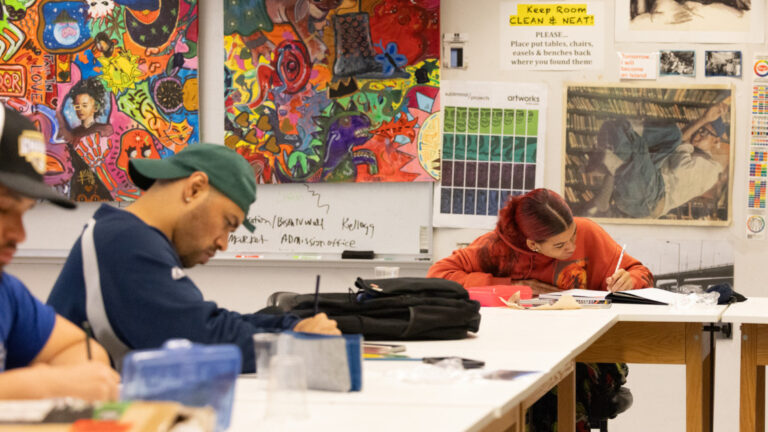
Students gain hands-on experience with contemporary tools, media, and processes while building a professional portfolio that reflects their interests and career goals. Emphasis is placed on visual storytelling, problem-solving, collaboration, and accessible communication practices.
Program Structure
Students may declare the Art + Visual Communication Design major after completing two foundation courses and two online training certifications.
Online Training Certifications
Online training certifications are noncredit learning experiences designed to ensure students enter specialized and upper-division courses with shared technical and disciplinary knowledge. Students must complete the required Foundational Proficiency Modules aligned with their selected specialization before enrolling in upper-division coursework.
Certifications include:
Adobe After Effects
Adobe Photoshop
Adobe Premiere Pro
Adobe Illustrator
Adobe InDesign
Autodesk Maya (3D)
Drawing I
Specializations
Students in the Art + Visual Communication Design major select one specialization. Each specialization provides focused coursework while remaining grounded in interdisciplinary studio practice and visual communication.
Pick One:
Animation
Film + Video
Fine Arts
Courses & Requirements
Summary of Requirements
| 2026-2027 | |
| Core Curriculum | 43 |
| Art Foundation Courses | 18 |
| Specialization Courses | 21 |
| Senior Capstone Courses | 12 |
| Required Elective Courses | 26 |
| TOTAL | 120 |
Art Foundation
This foundation course introduces students to major developments in modern and contemporary art from the Late 19th century to the present. The course analyzes painting, sculpture, architecture, photography, and films, and explores emerging visual practices within historical, social, cultural, and technological contexts. The emphasis is on understanding how modern art movements, materials, and ideas shape contemporary visual culture. Field trips to galleries, museums, and related institutions may supplement the course. This course prepares students for the upper-level coursework in specialization tracks.
This course introduces the foundational elements and principles of art and design, including space, line, shape, value, texture, color, and composition. Students engage in hands-on projects that explore design concepts in two-dimensional and three-dimensional formats relevant to multiple creative disciplines, including fine art, animation, and cinema/video. Emphasis is placed on visual problem-solving and basic design literacy. This course prepares students for upper-level courses in specialization tracks.
This course provides a foundational introduction to drawing, emphasizing principles, techniques, and processes. Through lectures and studio projects, students advance visual thinking, observation, and representation skills across various media. By the end of the course, students will demonstrate foundational drawing proficiency, preparing them for specializations coursework.
This course introduces students to AI-driven creative tools as a foundation in art + visual communication design. Students learn to generate prompts, integrate AI across multiple software platforms, and critically evaluate the ethical implications of AI-assisted production. Through hands-on studio projects, students apply AI to design, image-making, and content development while examining authorship, originality, and creative responsibility in contemporary practice.
This course provides a foundational study of visual communication and digital design principles. Students examine composition, typography, color, and image construction while developing technical skills in digital production methods. Through project-based learning, students apply conceptual thinking and design strategies to digital imaging, vector-based illustration, and layout projects using professional software. The course also introduces AI-assisted tools and examines their impact on authorship and originality. It prepares students for upper-level courses in specialization tracks.
This foundation course introduces core concepts, tools, and workflows in digital media. Students create digital media using video, motion, audio, and interactive projects with professional software and platforms. They build skills in visual storytelling, scripting, storyboarding, and prototyping, and examine digital media production in creative and professional contexts. The course emphasizes design thinking, audience experience, ethical considerations, and industry-informed practices. It also introduces AI-assisted tools and examines their impact on authorship and originality. The course prepares students for further study in digital and media-based coursework.
Animation Specialization
This course introduces students to critical analysis, visual literacy, and professional documentation practices across art and design disciplines. Students learn to evaluate visual work and communicate constructive feedback in written English and American Sign Language (ASL) using appropriate artistic vocabulary and ethical standards. The course also introduces digital photography and basic documentation techniques, including lighting, composition, and file organization, to support professional presentation of creative work. Through structured critiques, revision processes, and selected readings in contemporary art and visual culture, students develop critical thinking skills and professional communication practices necessary for all AVCD specializations.
This course introduces students to the core principles of animation through visual storytelling, perception, and image-making. Students explore how movement, timing, composition, and narrative function across animation, film, and digital media. Emphasis is placed on drawing for character development, visual literacy, and basic story concepts through sketches, motion studies, and short animation exercises. Through studio exercises and analysis, students explore storyboarding, visual planning, and basic motion studies applicable to both animation and cinema. Historical and contemporary examples from animation, cinema, video art, and motion graphics are used to support critical and creative development. The course builds a conceptual and practical foundation for further study in 2D, 3D, and stop-motion animation.
AVC 101, AVC 102, AVC 103, AVC 104, AVC 105, AVC 106, and AVC 201
This hands-on course introduces stop-motion animation techniques using physical materials, objects, and fabricated characters. Students explore frame-by-frame animation principles, lighting for miniature sets, camera control, and motion continuity. Projects may include puppet and object animation, as well as experimental hybrid approaches. Emphasis is placed on tactile storytelling, material exploration, and production discipline.
AVC 202 and ENG 376
This course offers an advanced exploration of a specific drawing medium or approach, which varies each time. Focus may include traditional, experimental, or digital practices such as mixed media, ink, charcoal, collage, life drawing, time-based, or digital platforms. Emphasis is on sustained studio practice, material investigation, and conceptual refinement within the chosen area.
This advanced studio course focuses on high-level animation rendering, including lighting design, materials, textures, shading, and final output optimization. Students refine completed animated sequences through cinematic lighting, rendering engines, and compositing techniques. Emphasis is placed on visual polish, professional presentation, and production-ready workflows aligned with industry expectations.
AVC 204
This advanced course introduces students to 3D animation workflows using professional-level software. Students develop skills in modeling, rigging basics, animation principles, camera movement, and rendering pipelines. Emphasis is placed on translating narrative intent into 3D motion while understanding professional production standards used in the animation, film, and game industries.
AVC 301
This course will employ critical literacy and graphic novels’ academic disciplines and encourage students to apply various popular graphic novels’ knowledge, modes of inquiry, and technological competence. In addition, students will learn and discuss how graphic novels can be used as resources for critical literacy and deliver messages about the current social issues. The reading assignments will provide a variety of situations and characters to develop moral reasoning skills to address the positions and challenges provided in the readings regarding the -isms and the balance of privilege/power.
Permission of the instructor
Film + Video Specialization
This course introduces students to critical analysis, visual literacy, and professional documentation practices across art and design disciplines. Students learn to evaluate visual work and communicate constructive feedback in written English and American Sign Language (ASL) using appropriate artistic vocabulary and ethical standards. The course also introduces digital photography and basic documentation techniques, including lighting, composition, and file organization, to support professional presentation of creative work. Through structured critiques, revision processes, and selected readings in contemporary art and visual culture, students develop critical thinking skills and professional communication practices necessary for all AVCD specializations.
AVC 101, AVC 102, AVC 103, AVC 104, AVC 105, AVC 106, and AVC 201
This course introduces students to the planning and design phase of cinema and video production. Students develop project concepts through research, scripting, storyboards, shot lists, schedules, and budgets. Emphasis is placed on visual planning, production logistics, team roles, accessibility considerations, and workflow organization from concept to delivery. Students learn industry-standard pre-production practices used in narrative, documentary, and media projects, with attention to Deaf-centered visual communication and inclusive production design. Projects focus on preparing production-ready materials rather than finished films.
AVC 207
This hands-on studio course introduces students to the multi-camera production environments used in television, live events, interviews, and streaming media. Students rotate through production roles, including directing, camera operation, lighting, audio, switching, and floor management. Emphasis is placed on teamwork, real-time decision-making, visual clarity, and accessibility-focused production practices. Students produce studio-based projects while learning professional workflows common in broadcast and digital studio environments.
AVC 208 and PFA 350
This advanced studio course allows students to produce substantial cinema or video projects of their own design. Students apply skills developed in previous courses to plan, produce, edit, and present a finished work in their chosen format. Emphasis is placed on creative voice, technical refinement, project management, critique, and professional presentation. Students participate in group critiques and reflect on process, intention, and audience engagement.
AVC 307
Fine Arts Specialization
This course introduces students to critical analysis, visual literacy, and professional documentation practices across art and design disciplines. Students learn to evaluate visual work and communicate constructive feedback in written English and American Sign Language (ASL) using appropriate artistic vocabulary and ethical standards. The course also introduces digital photography and basic documentation techniques, including lighting, composition, and file organization, to support professional presentation of creative work. Through structured critiques, revision processes, and selected readings in contemporary art and visual culture, students develop critical thinking skills and professional communication practices necessary for all AVCD specializations.
This course provides an in-depth survey of major developments in the history of art from prehistory through the early modern era. The focus is on the non-Western cultures and the West, with a study of architecture, painting, and sculpture across key historical periods. The course develops visual analysis skills and historical understanding essential for advanced fine art coursework. Field trips to galleries, museums, and related institutions may supplement the course.
AVC 101, AVC 102, AVC 103, AVC 104, AVC 105, AVC 106, and AVC 201
This course introduces traditional and experimental painting methods. Students develop technical and conceptual skills as they explore composition, visual organization, and expressive decision-making through studio projects. The course emphasizes iterative processes and the use of painting to communicate ideas and visual narratives. Discussions address how painting theory and practice may function in public contexts.
This course offers an advanced exploration of a specific drawing medium or approach, which varies each time. Focus may include traditional, experimental, or digital practices such as mixed media, ink, charcoal, collage, life drawing, time-based, or digital platforms. Emphasis is on sustained studio practice, material investigation, and conceptual refinement within the chosen area.
This course offers beginning study in a focused area of sculpture, with content varying by offering and including traditional, experimental, or digital approaches. Methods may include object-making, installation, digital fabrication, prop design, model building, and mixed-media fabrication. Emphasis is on construction processes, material systems, and sculptural thinking for physical form and spatial environments.
This course offers an in-depth exploration of printmaking practices. The instructor will focus on a specific medium, such as screen printing, collagraph, woodcut, linocut, lithography, or digital print processes. Students develop skills in materials, tools, and techniques while strengthening conceptual thinking and creative problem-solving. Through studio projects, students build technical proficiency and produce original works of art.
This course offers an advanced exploration of a selected painting medium or approach. Course content varies by offering and may include traditional, experimental, and hybrid painting practices such as oil, acrylic, watercolor, airbrushing, mural work, and digitally informed painting processes. Emphasis is placed on material exploration, compositional development, and the integration of concept and technique through sustained studio practice.
Senior Capstone Experience
This course is for senior students who have completed their two-year specialization in the Art + Visual Communication Design program. Students develop and refine original concepts for their capstone project while preparing for professional practice or graduate study. Through research and critique, students generate thesis ideas and submit a formal proposal requiring program approval before production begins. Working with a faculty mentor, students strengthen independent practice skills, including self-direction, time management, critical reflection, and professional communication. Students develop career-ready materials, including a resume, portfolio, and artist/designer statement, tailored to their post-graduation goals. The course also prepares students to plan the presentation of their work for the Senior exhibition, including exhibition layout, installation planning, documentation, and presentation strategy. Field experiences and critiques connect students to contemporary professional standards.
Permission of the program director
This course focuses on developing the approved Senior Thesis. Students begin producing a cohesive body of work that demonstrates advanced conceptual, creative, and technical skills within their specialization. Through weekly critiques and class discussions, students develop, refine, and document their thesis work. Emphasis is placed on incorporating concept, process, formal language, narrative structure, material exploration, and technical execution. The creative and technical skills developed throughout the program are applied at an advanced level as students move toward the year-long culmination of their thesis in this course and ART 403.
Specialization Production Expectations:
Animation
- Produce two animated works (1–2 minutes each)
- Demonstrate strength in storytelling, movement, timing, sound integration, and post-production workflow
Film + Video
- Produce two films (5–10 minutes each)
- Demonstrate strength in narrative structure, cinematography, editing, sound design, and production management
Fine Art
- Produce a cohesive body of at least five works
- Demonstrate strength in conceptual development, formal composition, material investigation, and presentation strategies
AVC 401
This course serves as the culminating Senior Thesis experience. Students finalize their approved body of work and refine their artist/designer statement to clearly express their conceptual framework, process, and professional direction. Students complete a professional portfolio, including documentation of year-round completed work and a finalized personal website appropriate for graduate study, residencies, freelance practice, or industry employment. Emphasis is placed on public presentation and professional standards. Students deliver a thesis presentation and, in partnership with a gallery, collaboratively plan, install, and operate the Senior Exhibition, gaining hands-on experience in exhibition design, promotion, and event coordination.
AVC 402
This course provides art majors with a supervised professional internship aligned with their area of specialization. In consultation with staff, faculty, or an approved site supervisor, students secure and complete an internship that supports their academic and career goals.
Permission of the program director
Recommended Elective Courses (26 credits)
Art + Visual Communication Design majors are required to complete 26 credits of approved Required Elective courses as part of the 120-credit degree plan. These courses must be taken across the four-year academic sequence to ensure development in professional practice, business literacy, media communication, and interdisciplinary collaboration.
The Required Electives strengthen students’ preparation in entrepreneurship, writing, marketing, production, technology, and Deaf cultural studies. Students will work with their advisor to strategically distribute these courses throughout their academic plan.
Approved Required Elective Courses include:
Business + Professional Foundations
In the real world, accounting is the language of business. Whether students will keep the book for their own small business, Working with nonprofit organization or function within a corporation, developing an understanding of how accounting procedures are applied in a business setting is crucial to their success. In this course we will use a '' Big Picture Approach'' and provide a conceptual overview of topics in accounting, such as basic income accounting, payroll, recording sales, receipts, payment and purchase transaction, maintaining ledger accounts, inventory and preparation of financial report. The course will utilize real world examples and incorporate computer technology. This course is NOT restricted to current Gallaudet University undergraduate degree seeking students or to students majoring in accounting or other business fields. Students do NOT need to have experience in business or accounting in order to enroll in this course. For those students who may plan to take Principle of Accounting course in future, this may be a great starting point.
This course examines the basic principles of marketing and provides the opportunity to develop the critical analysis and management skills needed by successful marketers. Within the framework of the ''product, price, promotion, distribution, and customer'' elements of marketing, course topics include market segmentation, targeting, positioning, consumer behavior, integrated marketing communication, marketing ethics and social responsibility, and the global dimensions of marketing (including e-marketing).
C+ or better in BUS 101
Deaf Studies + Cultural Context
DST 205
Writing + Communication
This course covers areas of vocabulary, semantics, grammar and organization of ASL and English. Students look at the linguistic aspects of both languages and compare the two. The class also covers word classes and sentence structure of both languages. To assist students in understanding the structure of both languages, discussion of how languages work is included.
LIN 201, ENG 102 and ASL 125 or equivalent
Visual media has changed the way we work with American Sign Language. With the advent of new tools and platforms, possibilities of publishing have proliferated, allowing a wider discourse of ideas to be shared with a vast audience of people who work with ASL and ASL learners. This course explores these opportunities through a hands-on approach and introduces students to the tools and skills necessary to produce digital video, websites, interactive presentations and social media and integrate those with the field of ASL.
ASL 125
Surveys genres and modalities of professional writing, including social media and writing for the web. Provides an overview of areas such as digital publishing, new media journalism, business and technical writing, and editing. Develops a rhetorical understanding of professional writing as the ability to write in response to elements including audience, purpose, medium, and design.
ENG 102 and permission of the instructor.
Study and intensive practice of writing in digital environments, with a focus on journalistic contexts. Examines technical and rhetorical features of online environments, including interactivity, hyperlinking, spatial orientation, and non-linear storytelling. Focuses on the writing conventions and standards of digital media, as well as editing techniques and competencies.
ENG 250 or permission of the instructor.
Study and intensive practice of composition in social media genres. Examines rhetorical conventions for digital communication and the dissemination of information through social media for professional purposes, including developing a social media content strategy and analytics. Integrates editing techniques and competencies. May also cover theoretical issues such as copyright and authorship, visual literacy, and moderation of collaborative online environments.
ENG 250 or permission of the instructor.
Study of media literacy, including techniques and strategies used to analyze the use of diverse media to inform, entertain, and sell. Examines diverse media messages in advertisements, television, film, newspapers, magazines, and the Internet.
This course will employ critical literacy and graphic novels’ academic disciplines and encourage students to apply various popular graphic novels’ knowledge, modes of inquiry, and technological competence. In addition, students will learn and discuss how graphic novels can be used as resources for critical literacy and deliver messages about the current social issues. The reading assignments will provide a variety of situations and characters to develop moral reasoning skills to address the positions and challenges provided in the readings regarding the -isms and the balance of privilege/power.
Permission of the instructor
Study and intensive practice of professional writing skills and genres, with a focus on grant applications and reports, letters of introduction, and other fundraising materials.
ENG 380 or permission of the instructor.
Qualifying performance on the English assessment screening and passing ASL screening.
Technology + Web
This course introduces fundamental concepts of computer programming. Students learn program logic, flow charting, and problem solving through analysis, development, basic debugging and testing procedures. Topics include variables, expressions, data types, functions, decisions, loops, and arrays. Students will use the knowledge and skills gained throughout this course to develop a variety of simple programs.
Pre- or co-requisite: MAT 130 or permission of instructor.
This course introduces internet technology and the principles and techniques necessary for successful web development. Topics such as HTML5, Cascading Style Sheets, JavaScript, DOM, jQuery, multimedia, web page design and web site publishing are presented. Students will learn to develop attractive and interactive web pages and applications.
ITS 110 with a grade of B or better, or permission of the instructor.
Production and Performance Practice
Students may not substitute courses outside this approved list without program director approval.
This course provides students an opportunity to earn academic credit by working behind the scenes in support of the design and technical aspects of a theatre production being mounted per semester. Students will develop practical skill sets and an essential knowledge of the logistics required for the successful mounting of a theatre production by working in one of its related areas: stage management, scenery, lighting, costumes, props, technical production.
The student’s specific assignment will be made by the theatre faculty and/or technical director ahead of each production, taking into consideration each student’s experience and the technical needs of each production.
For Theatre majors:
PFA 281 and PFA 282 may be taken repeatedly—either as all PFA 281, all PFA 282, or any combination of both—toward a minimum total of nine (9) practicum credits. After fulfilling this requirement, either course may be taken again for elective credit by students who wish to pursue additional production experience. Both courses count toward CORE/Engage requirements as well as the nine-credit Theatre Arts major practicum requirement. Students who have already satisfied one or both of these requirements may continue to enroll in PFA 281 and/or PFA 282 for additional elective credit.
For Theatre minors:
PFA 281 and PFA 282 may be taken repeatedly—either as all PFA 281, all PFA 282, or any combination of both—toward a minimum total of six (6) practicum credits. After fulfilling this requirement, either course may be taken again for elective credit by students who wish to pursue additional production experience. Both courses count toward CORE/Engage requirements as well as the six-credit Theatre Arts minor practicum requirement. Students who have already satisfied one or both of these requirements may continue to enroll in PFA 281 and/or PFA 282 for additional elective credit.
For non–Theatre majors and minors:
PFA 281 and PFA 282 may be taken to satisfy a CORE/Engage requirement and/or as free elective credit. These courses may be repeated up to four (4) times per course.
Permission of the instructor
This course allows students to earn academic credit by performing as an actor or serving as a member of a stage management team in a theatre production directed by Performing Arts faculty or guest artists. Enrollment requires attendance and active participation in all scheduled rehearsals, meetings, and performances.
Only students who have been cast or assigned to a stage management role in a production directed by Performing Arts faculty or guest artists should register for Performance Practicum. Students participating in productions not directed by Performing Arts faculty may be eligible for credit with prior faculty approval.
For Theatre majors:
PFA 281 and PFA 282 may be taken repeatedly—either as all PFA 281, all PFA 282, or any combination of both—toward a minimum total of nine (9) practicum credits. After fulfilling this requirement, either course may be taken again for elective credit by students who wish to pursue additional production experience. Both courses count toward CORE/Engage requirements as well as the nine-credit Theatre Arts major practicum requirement. Students who have already satisfied one or both of these requirements may continue to enroll in PFA 281 and/or PFA 282 for additional elective credit.
For Theatre minors:
PFA 281 and PFA 282 may be taken repeatedly—either as all PFA 281, all PFA 282, or any combination of both—toward a minimum total of six (6) practicum credits. After fulfilling this requirement, either course may be taken again for elective credit by students who wish to pursue additional production experience. Both courses count toward CORE/Engage requirements as well as the six-credit Theatre Arts minor practicum requirement. Students who have already satisfied one or both of these requirements may continue to enroll in PFA 281 and/or PFA 282 for additional elective credit.
For non–Theatre majors and minors:
PFA 281 and PFA 282 may be taken to satisfy a CORE/Engage requirement and/or as free elective credit. These courses may be repeated up to four (4) times per course.
Permission of the instructor, gained through audition and/or assignment of performing or stage management role(s).
Admissions
Learn about Gallaudet’s admissions requirements, steps to apply, application deadlines and more at our Undergraduate Admissions page.
First-time College Students Transfer International Students Visiting StudentsTuition and Financial Aid
Accessibility is core to everything we do at Gallaudet. You see it in the quality of our interpreters and the design of our campus buildings. That philosophy extends to our costs and aid. We’re committed to ensuring students from all financial backgrounds are able to obtain a world-class education.
Contact
- B.A. in Art + Visual Communication Design
- scott.carollo@gallaudet.edu