



This summer, ten undergraduate scholars from colleges and universities across the country came to Gallaudet for ten weeks of hands-on research at the frontier of accessible technology. The Research Experience for Undergraduates in Accessible Information and Communications Technologies (REU AICT), a National Science Foundation-funded program hosted by Gallaudet, ran from May 18 through July 24, 2026, and immersed its cohort in mentored research projects designed for every community, including the Deaf, hard of hearing communities.
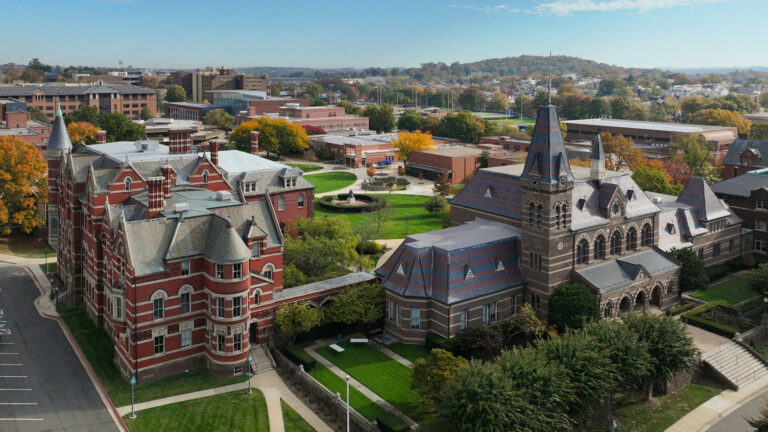
The program is led by Principal Investigator Dr. Raja Kushalnagar, and Co-Principal Investigator Dr. Christian Vogler, together with faculty mentors Drs. Abraham Glasser, Kara Hawthorne, and Chizuko Tamaki, along with graduate mentors Clayton Lewis and Michaela Okosi, and research staff Shela Atemnkeng. Housed within Gallaudet’s Artificial Intelligence, Accessibility, and Sign Language Center, REU AICT gives undergraduates a rare opportunity: to conduct accessibility research not merely about deaf and hard of hearing people, but with and alongside them, in the world’s premier signing academic community.
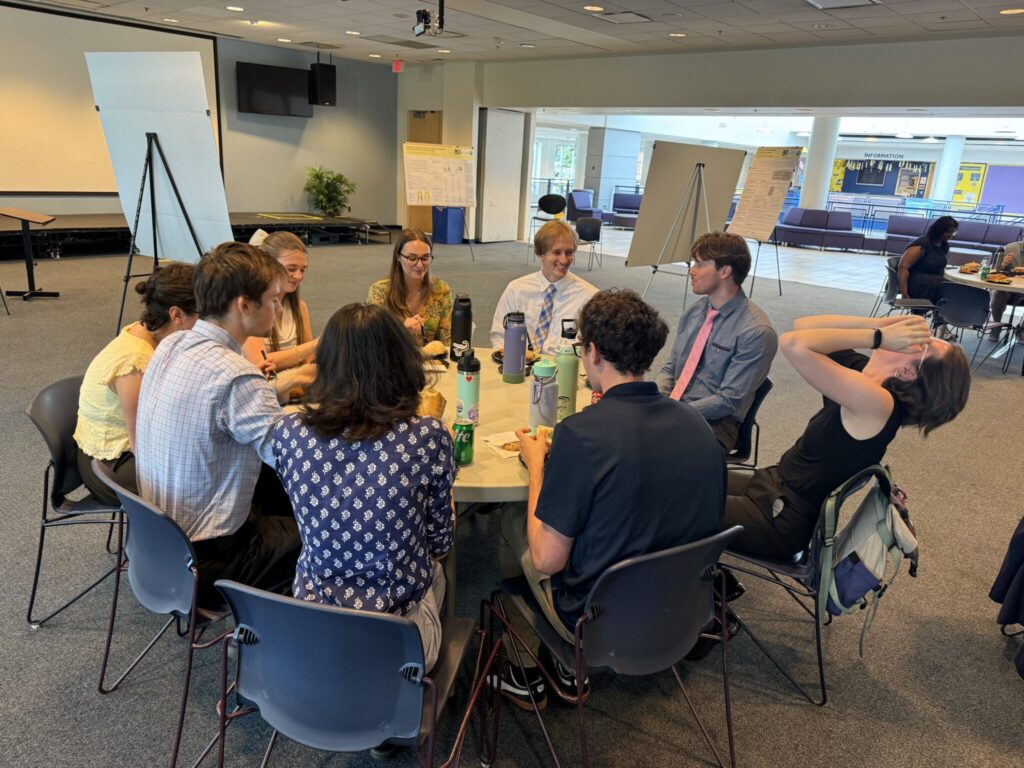
“This cohort shows what becomes possible when accessibility research happens inside a signing community rather than at a distance from it,” said Kushalnagar. “Our scholars arrived with questions and left with findings, prototypes, and a conviction that accessible technology is best built with the communities it serves. Every summer, this program renews my optimism about where the next generation will take this field.”
A cohort as diverse as the field
The 2026 cohort reflected the breadth of the accessible technology field. August Taylor (Haverford College), Aniela Haines (University of North Carolina at Chapel Hill), Ben Zifcak (University of Delaware), and Cheyenne Brown (Princeton University) brought backgrounds in computer science, mathematics, and linguistics. Sophia Garcia (Palomar College) came to the program from ASL-English interpreting and Deaf studies, while Jackson Wagner (Illinois State University) is preparing for a career in Deaf and hard of hearing special education. Eric Stecher (Cal Poly Pomona), a Child of Deaf Adults (CODA) and native signer, contributed expertise in electrical engineering and hardware design, and Sarah Swee (Cornell University) brought training in statistics and human-computer interaction. Rounding out the cohort were Gallaudet’s own Kodi Lee and Catelina Martinez, both Information Technology majors.
Many members of the cohort brought lived experience as deaf or hard of hearing individuals, CODAs, or members of signing communities. Their experience shaped both the questions they asked and the technologies they built. Over the ten weeks, scholars completed at least 40 hours of research per week, participated in weekly seminars and professional development workshops, and lived together on campus, building the kind of collaborative community of practice the program is known for.
From research questions to results
Working in five two-person teams alongside faculty, staff, and graduate mentors, the scholars carried their projects from research question to results in a single summer.
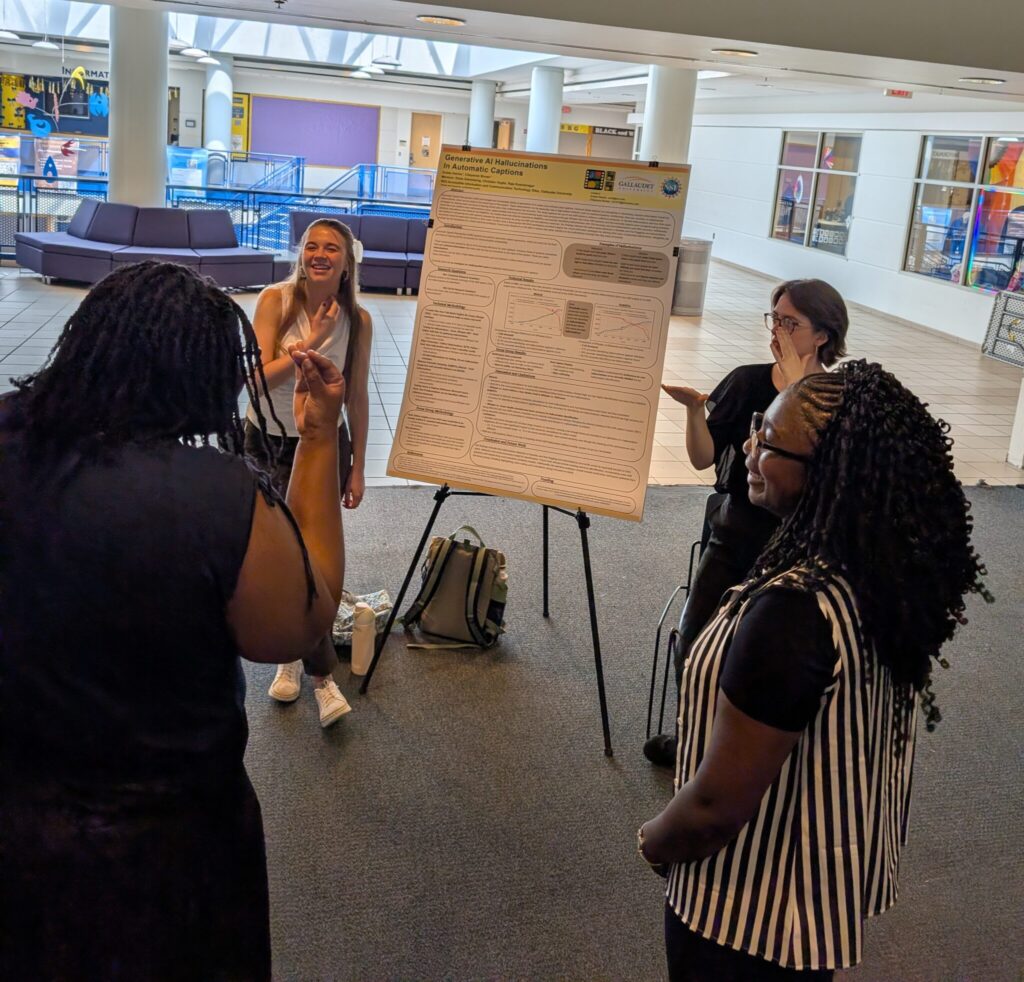
Haines and Brown took on a growing hazard in AI-generated captions: hallucinations, in which a speech recognition system fabricates fluent text that has no connection to what was actually said. By running conversational audio through two different recognizers and comparing the outputs with semantic-similarity models, they showed that hallucinations can be flagged without a human reference transcript. Their best model identified hallucinations with 70 percent accuracy and non-hallucinations with 88 percent. A focus group of deaf and hard of hearing participants shaped their recommendations for subtle, non-distracting visual alerts, laying the foundation for a future real-time prototype.
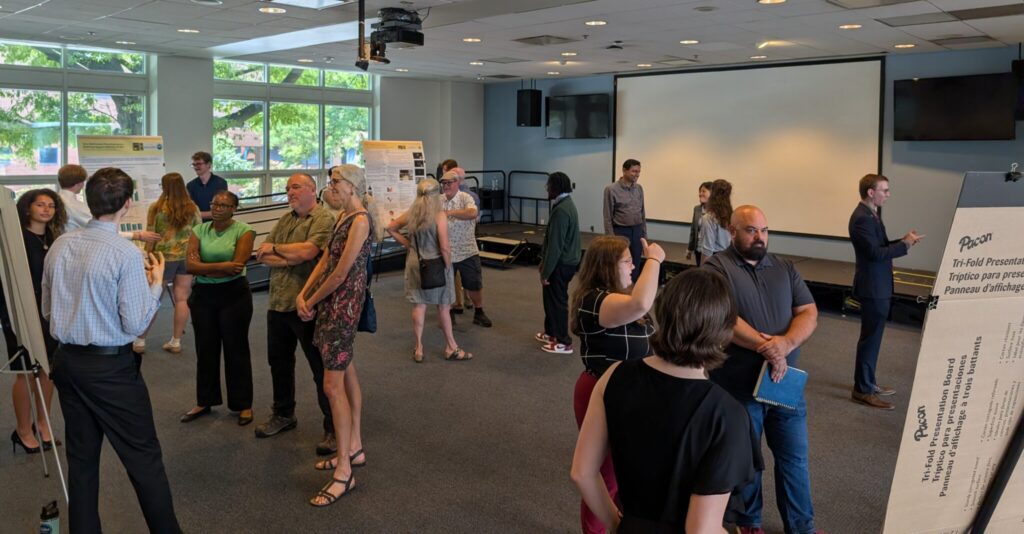
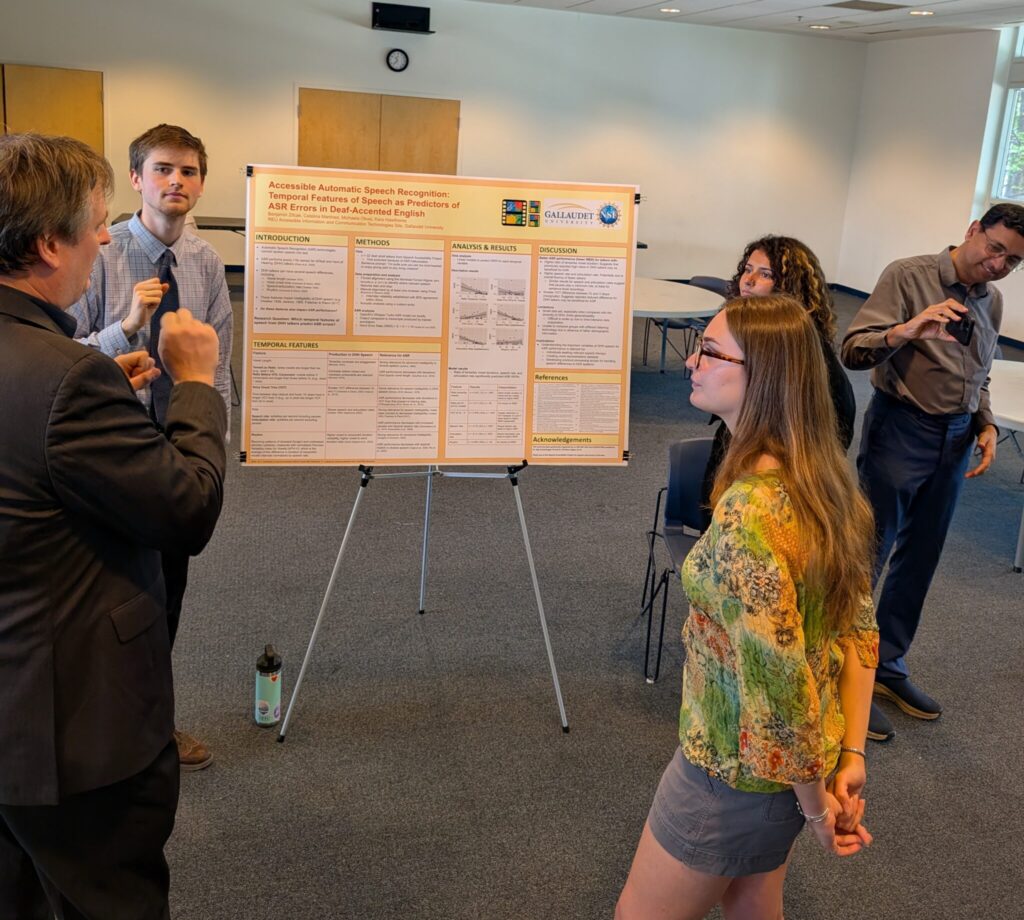
Zifcak and Martinez asked why automatic speech recognition performs so much worse for deaf and hard of hearing talkers. Analyzing recordings of 22 deaf adults from the Speech Accessibility Project, they found that temporal features of deaf-accented English, in which the duration ratio of tense to lax vowels, speech rate, and articulation rate, significantly predicted recognition errors, results that point toward more representative training data and speech-aware processing in future ASR systems.
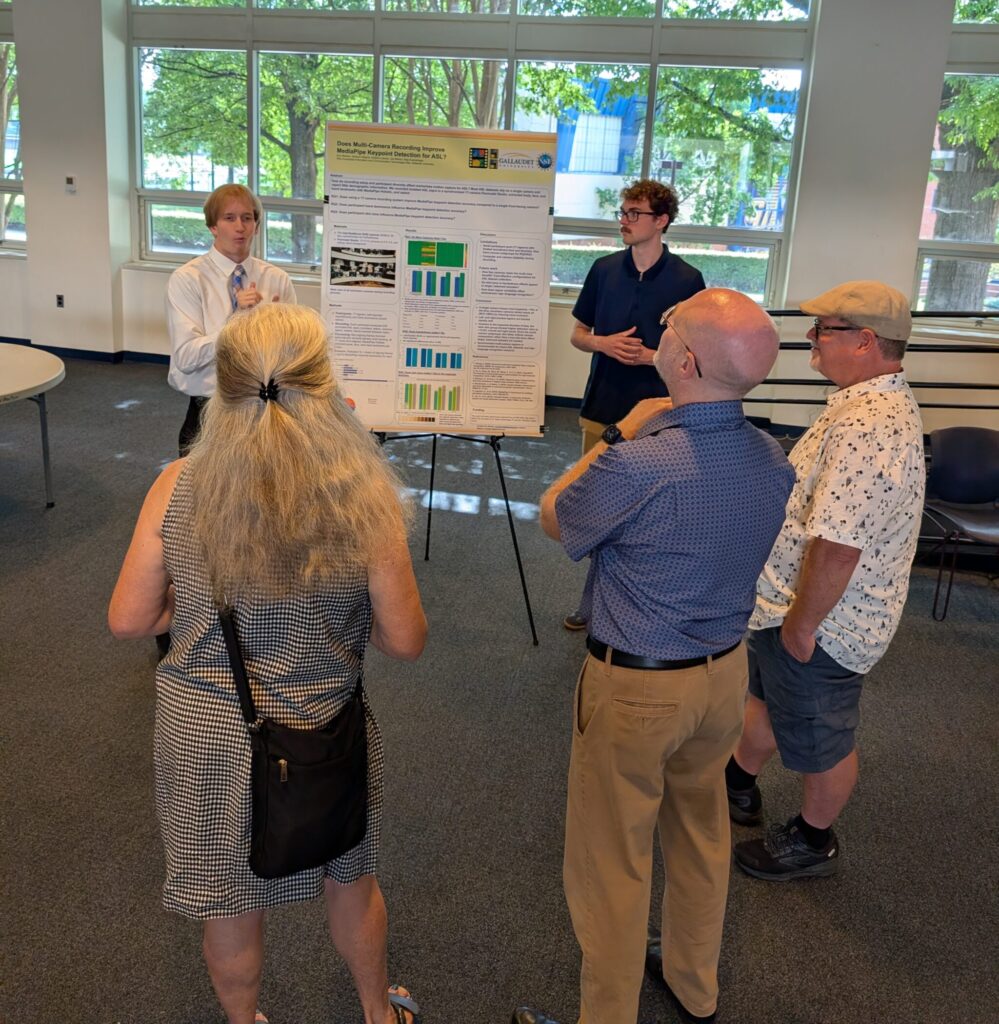
Stecher and Wagner tested whether multi-camera recording improves markerless motion capture for American Sign Language (ASL). Recording 17 signers producing more than 200 signs each in a synchronized 17-camera studio, they found that a single front-facing camera misses hand keypoints roughly 19 percent of the time, while the full camera array detects them nearly 100 percent of the time by eliminating occlusion. This is a concrete recommendation for how future ASL datasets should be collected.
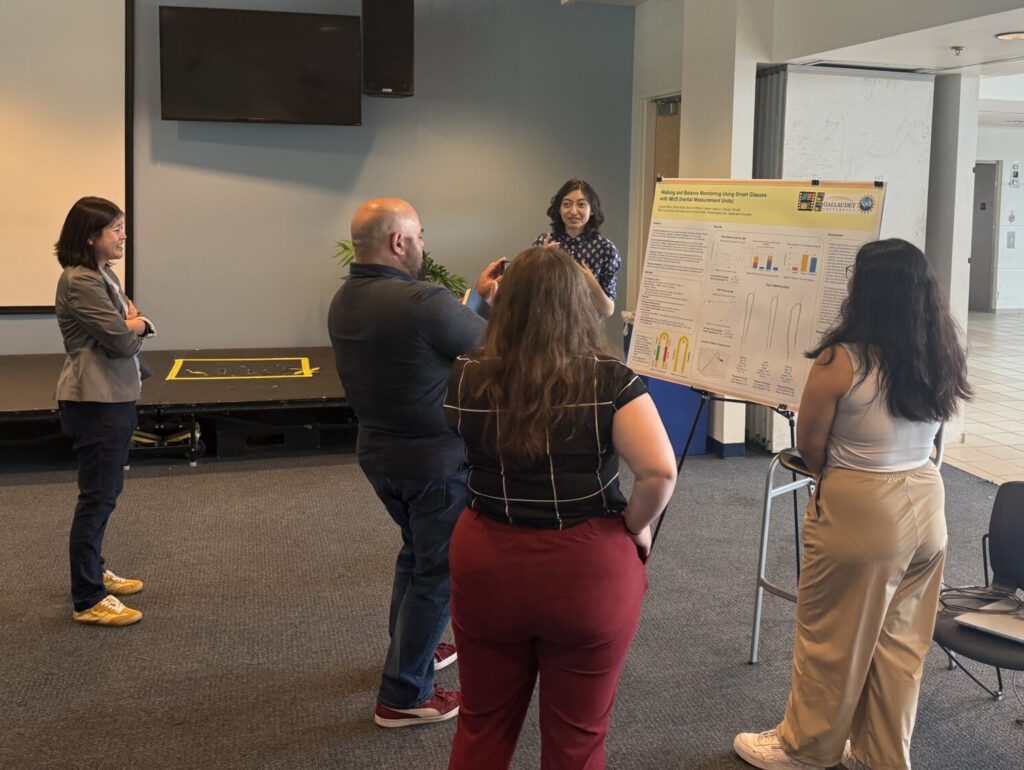
Taylor and Swee explored whether smart glasses with built-in inertial measurement units can monitor walking and balance in everyday life, which is a question with real stakes for deaf and hard of hearing people, who experience vestibular challenges and fall risk at elevated rates. They put 31 participants ranging in age from 18 to 78 through clinical balance tests and instrumented walking trials, characterizing both the promise of the approach and the motion-tracking limitations that current hardware must overcome.
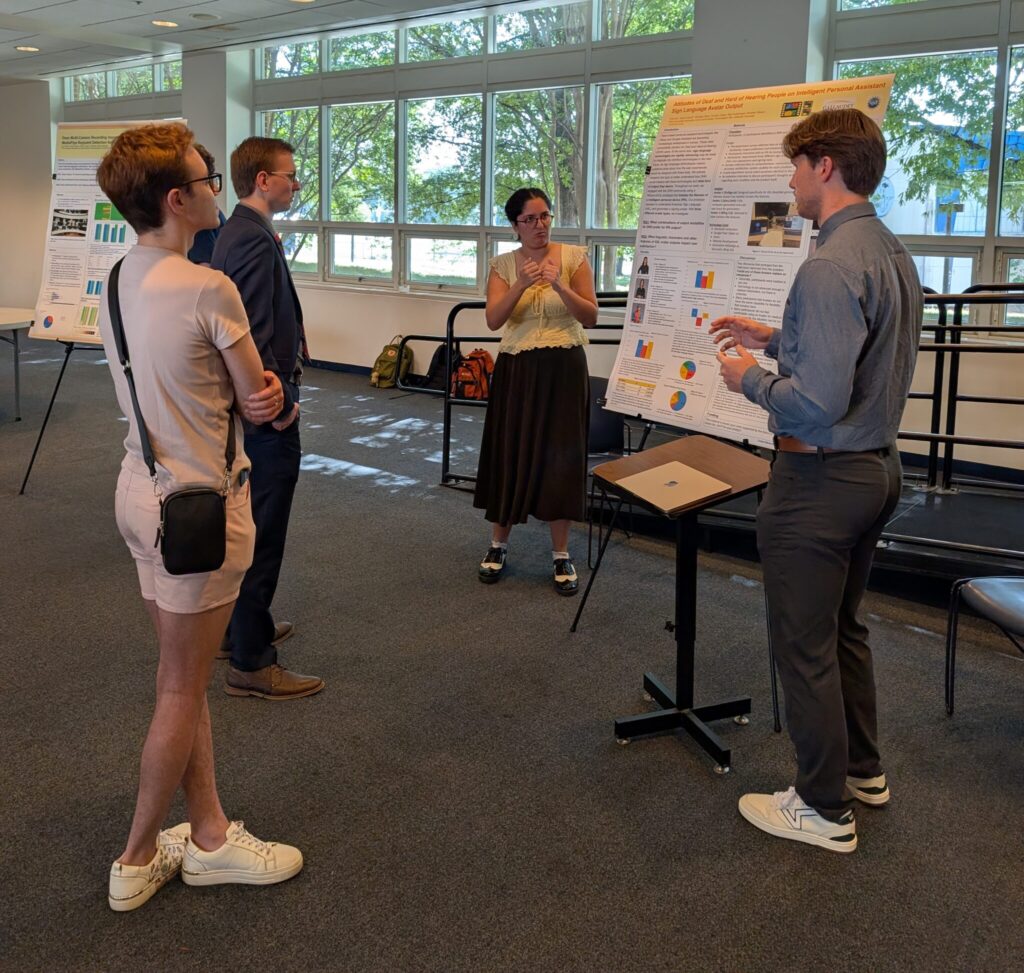
Lee and Garcia investigated how deaf and hard of hearing users want intelligent personal assistants — technologies like Alexa and Siri, to talk back in sign language. Using a Wizard-of-Oz prototype that appeared to understand ASL and respond through three different signing avatars, they found that participants’ preference for signing-avatar output jumped from 58 percent before the study to 83 percent afterward, and that an avatar’s appearance matters alongside its linguistic accuracy in earning users’ trust.
The program culminated on Wednesday, July 22, with a poster session and research showcase. AICT scholars presented their findings to faculty, staff, students, and visitors, fielding questions in ASL and English and demonstrating how much ground a dedicated researcher can cover in a single summer. Each scholar also authored a written research report, and several projects are expected to be submitted to professional conferences, a hallmark of the program, whose alumni have gone on to publish and present their REU work nationally.
REU AICT develops young researchers of deaf, hard of hearing, or fluent signers, to carry accessibility-first thinking into graduate programs and careers in computing, engineering, and design. Scholars receive a $7,000 stipend, campus housing, meals, and travel support, thanks to National Science Foundation funding. Applications for the Summer 2027 cohort will open in the fall. Undergraduates in computer science, information technology, psychology, linguistics, communications, and related fields are encouraged to apply.
For more information, visit the REU AICT program page or contact Click to reveal email.
The REU AICT program is supported by the National Science Foundation under Award No. 2447704. Any opinions, findings, and conclusions or recommendations expressed in this material are those of the authors and do not necessarily reflect the views of the National Science Foundation.