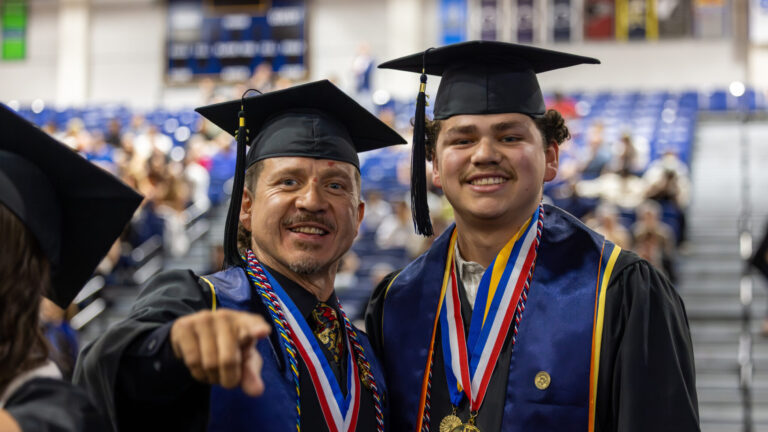
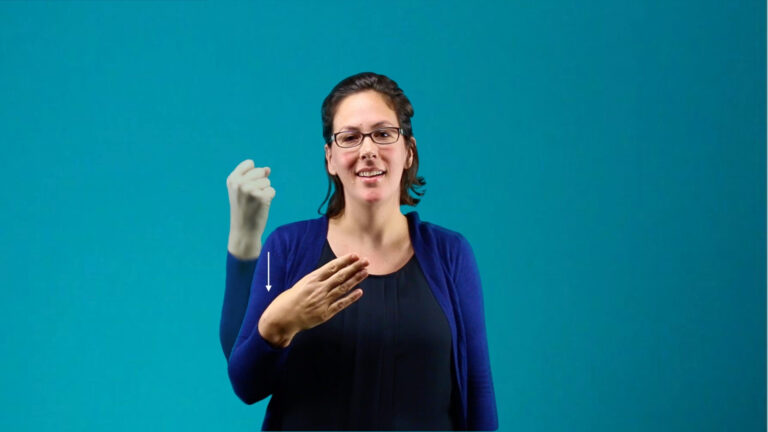
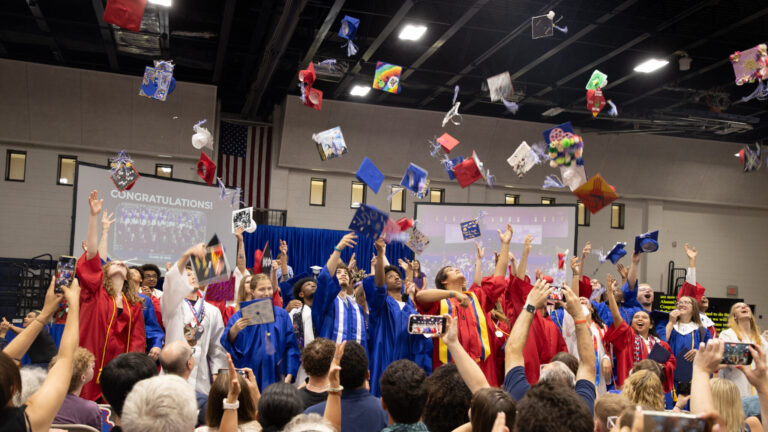


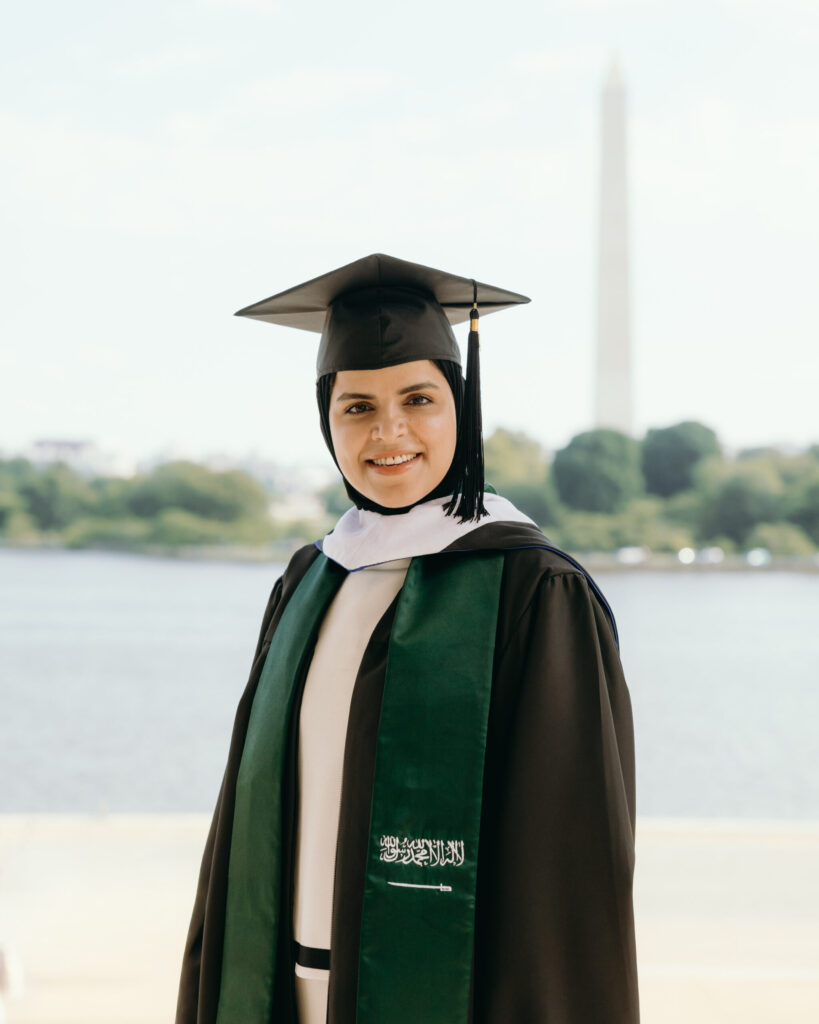
Wadha Alshammari, G-’26, stood on the Commencement stage and smiled at the crowd. As her eyes passed over her fellow graduates, she pointed at them.
“All of you have something special inside. When people try to deny your dreams, stay strong. Move forward with confidence and reach for the stars.”
Alshammari spoke from experience. She had arrived on the Gallaudet campus without knowing sufficient English or American Sign Language (ASL) to begin her graduate studies. Now, she was the Graduate Student Speaker at the Commencement 2026 ceremony. The room followed her every move as she used ASL to deliver a confident speech.
Forty minutes later, Alshammari walked across the stage again to receive her Master of Arts in Deaf Education Studies. It marked the culmination of a lifelong dream. And the beginning of something even greater.
Growing curiosity
Alshammari was born and raised in Hail, Saudi Arabia. She is the youngest of nine siblings. At one year of age, she became deaf after contracting spinal meningitis. Shortly after, her mother passed away from cancer. When Alshammari was 13 years old, her father passed away after a car accident.
Her siblings stepped up. The family used home signs to ensure that Alshammari had full access. Whenever access barriers outside of the home prevented Alshammari from getting the answers she wanted, she would bring questions back to her siblings. They would use the opportunity to foster her curiosity.
“Curiosity shaped my childhood,” she says. “I was constantly exploring my hometown, fascinated by unusual objects, and inclined to take apart metal things to understand how they worked. I had an endless supply of questions.”
“Long before the world saw her story, we knew Wadha was extraordinary,” says Alshammari’s brother Suliman. “Since she was a little girl, she has always been exceptionally smart, curious, and determined. This is not just a graduation story. It is a story of courage, persistence, faith, and a meaningful mission to make a real difference in Deaf education in Saudi Arabia.”
The Gallaudet goal
Alshammari attended a deaf school in Hail with nine students. She learned Saudi Sign Language (SSL) and found deaf peers, but something was missing.
“I enjoyed learning and playing at school,” Alshammari says, “but the teachers didn’t encourage us to be proud deaf people. I didn’t have full access to information. I still had to ask my family to fill in the blanks.”
Alshammari’s family sparked the beginning of her next journey. When she was 13 years old, her brother Muhannad visited home during a break from his college studies in New Zealand. Together, they searched online for schools for the deaf and discovered Gallaudet University. She could hardly believe such a place existed.
Alshammari went to her sister Athra and declared that she wanted to attend Gallaudet one day. “Athra told me to follow my heart,” Alshammari remembers. “From that day forward, my dream was set.”
Alshammari studied the history of Gallaudet University and found herself confused by two words: “deaf identity”. She approached Athra again.
“My sister told me that deaf identity is something inside me. A self-belief beyond logic. I didn’t understand at the time. Years later, when I arrived at Gallaudet, I finally understood. My deaf identity awakened immediately.”
Finding purpose
When Alshammari graduated from high school, attending Gallaudet wasn’t an option. At the time in Saudi Arabia, women were not allowed to live outside of the country without being accompanied by a male relative. Instead, she attended the University of Hail in her hometown and graduated with a bachelor’s degree in Special Education.
“The system fails deaf children,” Alshammari says. “I want to foster the same curiosity in them that my family gave me.”
By 2018, Crown Prince Mohammed bin Salman enacted a royal decree in Saudi Arabia which allowed women greater access to education and other opportunities. Alshammari immediately secured a passport that allowed her to travel alone. One year later, her Gallaudet application was approved.
Before Alshammari could make her way to Washington, D.C., the COVID-19 pandemic struck. The entire world entered a state of limbo, and Alshammari was forced to wait a little longer.
Access at last
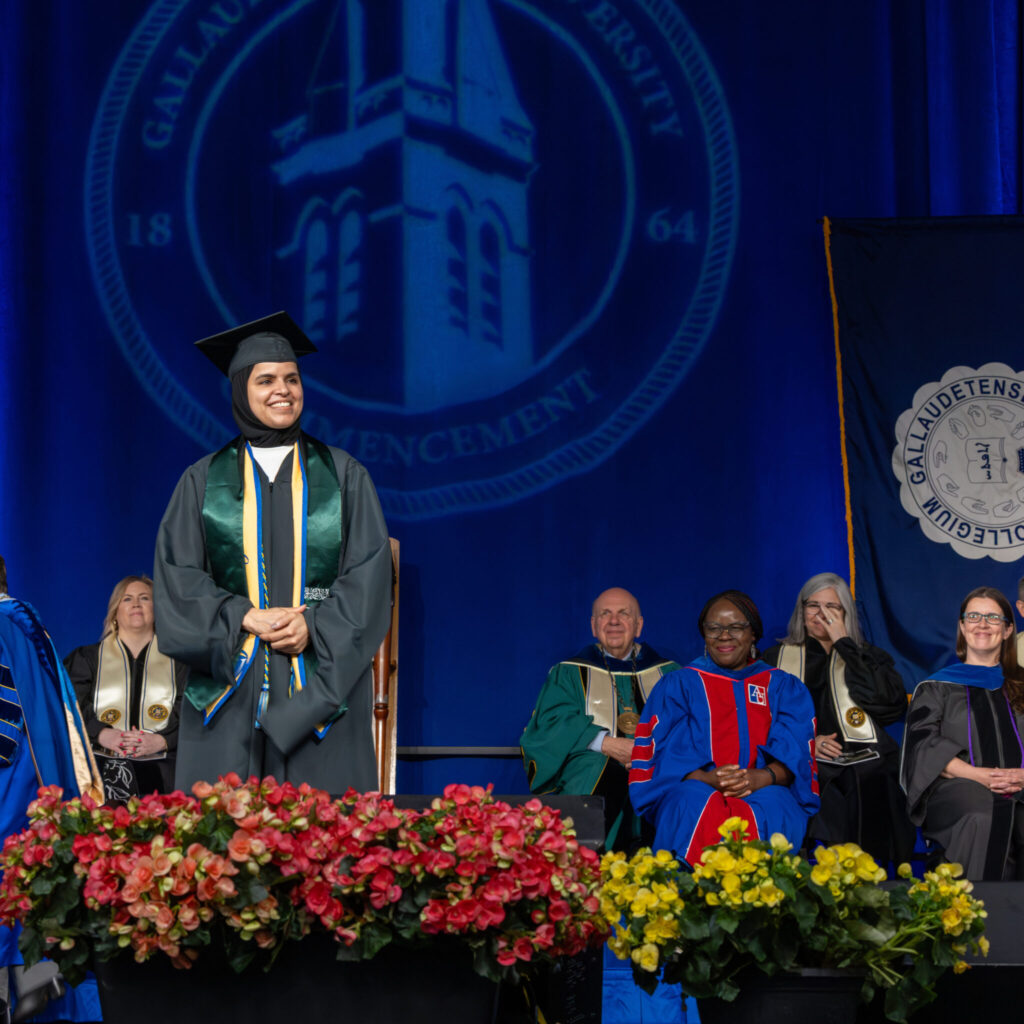
In 2021, Alshammari finally arrived on the Gallaudet campus. She began in the English Language Institute (ELI), which teaches English and ASL to international students. Alshammari felt at home immediately in the deaf-centered environment of Gallaudet. For the first time in her life, she had full access to all the information and interaction she craved.
“It only took a few days for me to feel like I found my deaf identity,” Alshammari says. “Here at Gallaudet, there are so many deaf people who aren’t ashamed of their identity. I took full advantage of that by meeting as many people as I could, even when I was still learning ASL.”
Alshammari loved learning alongside deaf people from around the world, including other Saudis. Her language foundation in SSL and home sign allowed her to learn ASL quickly. She then used ASL to learn English.
Alshammari’s experience in ELI gave her new insight into her childhood struggles. She remembers feeling dismissed in writing classes during her elementary school days. “I would write from my heart, but my sentences were influenced by sign language grammar. My teacher laughed at my writing instead of helping me. It hurt me deeply. That memory stayed with me for a long time.”
Years later, her studies at Gallaudet University helped her understand that experience in a new light.
In her Deaf Education courses, Alshammari learned that deaf children do not struggle with writing because they lack ideas. Rather, they are often asked to write in a language they have not fully accessed, while the structure of their signed language is often misunderstood or dismissed.
Research Gallaudet’s Visual Language and Visual Learning Center and other scholars has shown that early sign language acquisition supports literacy, cognition, and social development. Studies have also found a relationship between sign language proficiency and reading development when teachers help students connect signed language with written text.
“When I learned about ASL linguistics and ASL gloss, I finally understood that signed languages have their own structure, rules, and beauty. I felt proud of being deaf. When I was a child, I used to feel embarrassed, but now I understand myself better. I wish every Deaf child could grow up with that same pride, instead of feeling ashamed of their language.”
That realization reinforced Alshammari’s growing commitment to Deaf education. She began to see her childhood experiences not as personal failures, but as examples of what can happen when deaf children lack full language access, and teachers lack an understanding of language development in deaf children.
A natural educator
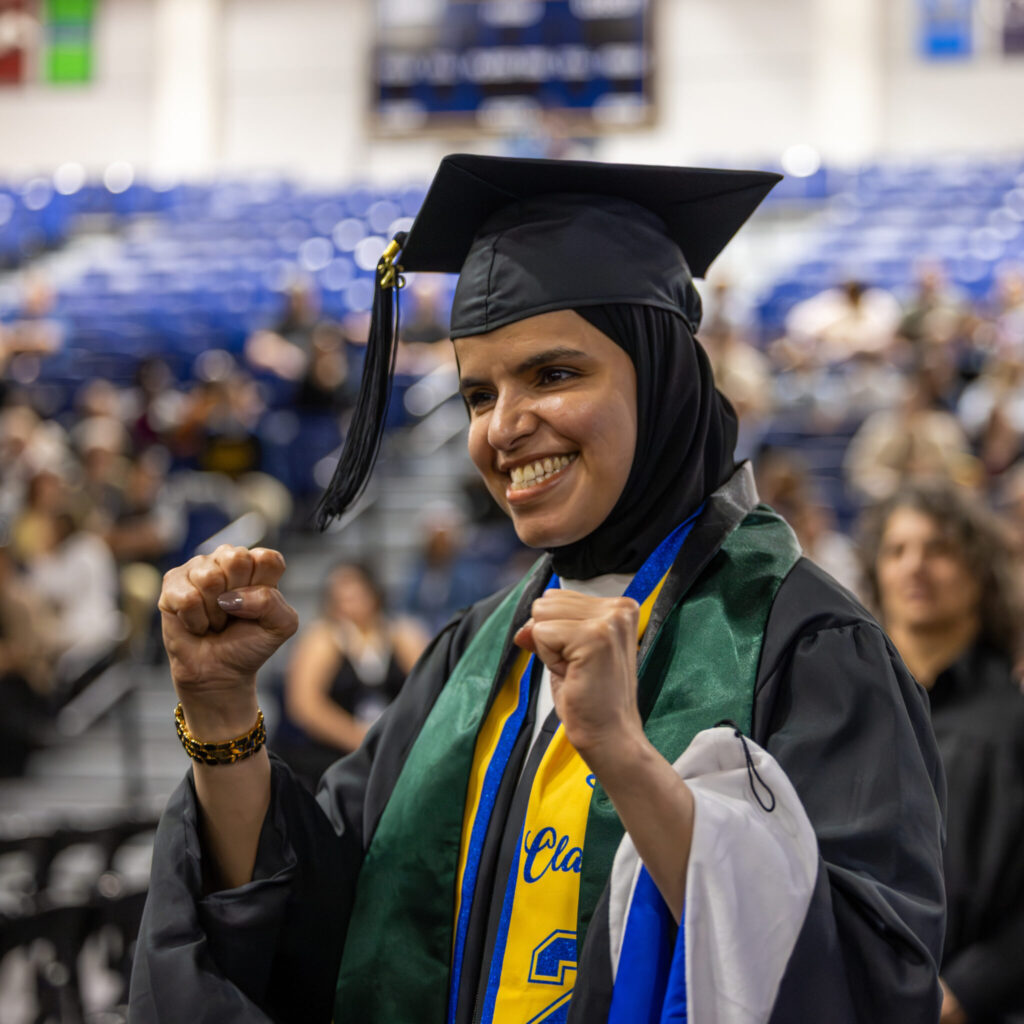
The fully accessible classroom environments at Gallaudet made learning easier than ever before for Alshammari. “There was always something missing for me inside hearing classrooms,” she says. “Gallaudet is all about access. I loved all my courses and especially enjoyed learning from deaf teachers.”
In 2024, Alshammari began studying for her master’s in Deaf Education Studies. She dedicated herself to her coursework, knowing the skills she learned would be uniquely useful in her home country. That same year, she participated in a groundbreaking project that promoted cognitive science education for deaf K-12 students.
Deaf Education instructor Allison Gibbons, G-’07, sees big things in Alshammari’s future. “I have no doubt she will make a positive impact in Deaf Education. It may be a challenge, but Wadha’s personality can empower others to join her in her fight to improve Deaf Education anywhere she goes.”
“In Saudi Arabia, many deaf babies are identified through a medical or disability lens,” Alshammari says, “and families are not always given enough information about sign language, the deaf community, or Deaf culture. As a result, some families focus only on fixing hearing loss instead of understanding that their child actually needs full language access.”
At Gallaudet, Alshammari was exposed to a different way of understanding deaf identity and Deaf Education. She learned that being deaf is more than a label. It can also be a linguistic and cultural identity.
Research shows that early sign language acquisition can support deaf children’s spoken and written language development, rather than harm it. According to the World Federation of the Deaf (WFD), deaf children should have access to their national sign language from birth, as well as opportunities to interact with deaf professionals and community members.
“My classes at Gallaudet changed how I understood Deaf education,” says Alshammari. “I learned how to use assessments to develop age-appropriate education plans for deaf children. Deaf children need more than hearing tests and labels. They need early language access, family support, assessment, age-appropriate education plans, deaf role models, and exposure to Deaf culture and community.
“I want to bring this understanding back to Saudi Arabia so deaf children and their families can see being deaf is not a disability. It is a culture, identity, and source of pride.”
Dreaming big
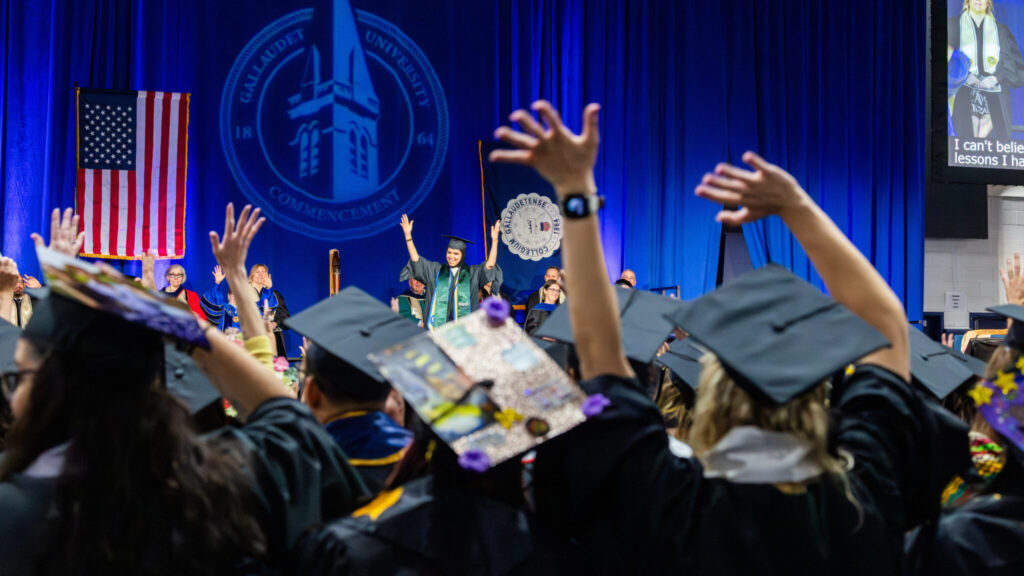
Alshammari’s speech at Commencement 2026 began by emphasizing the importance of access. Alshammari thanked her family for encouraging her curiosity. She also recognized the importance of the language foundation they gave her by using sign language in the family home.
“The earliest education happens at home,” she signed to the crowd. “As a child, I would use the things I learned at home to help my classmates. That’s where I first developed a love of teaching.”
Alshammari thanked the Gallaudet community for welcoming her. “When I first arrived at Gallaudet, I saw the Tower Clock with its flag waving in the wind. Everywhere I looked, there was signing and protactile. I knew I was home. I finally knew the meaning of belonging.”
Other lessons in Alshammari’s speech touched on resilience, chasing one’s dreams, and the importance of paying it forward.
“I will bring all the lessons I learned here at Gallaudet to Saudi Arabia and use them to educate the deaf community there,” Alshammari signed on the Commencement stage. She turned to her fellow graduates. “I hope you share your brilliance with the world, too.
“Growing up, I had to rely on my family to explain everything to me. Children shouldn’t have to depend on their families to access information at school, and not every deaf child is as fortunate to have the kind of support that I did. I want all deaf children to have full access and the opportunity to follow their dreams.”
Now that she’s graduated, Alshammari has a new dream for herself. She wants to establish her own signing-only school for deaf children in Saudi Arabia. If her journey so far is any indication, it won’t be a dream for long.
Gallaudet is the world’s leading institution in Deaf Education. Visit the Education program page to learn more.
Visit the International Admissions page to see Gallaudet’s resources for international students.