

Gallaudet University’s Accessible Human-Centered Computing and Policy (AHCP) program made a landmark showing in May at DeafTech 2026, the world’s first dedicated international conference on Deaf technologies. Researchers, technologists, advocates, and policymakers from across the globe gathered at TU Wien (Vienna University of Technology) in Vienna, Austria, for two days of papers, workshops, posters, and live demonstrations.
Of the twelve peer-reviewed papers accepted into the conference program, five were authored or co-authored by Gallaudet faculty and students. Gallaudet’s five papers reflect a consistent research agenda — one that places Deaf communities at the center of every design decision, from the earliest stages of participatory research through evaluation and policy.
DeafTech was founded on the principle that deaf communities must lead and shape the technologies that affect them. The inaugural event was conducted entirely in International Sign and designed as a deaf-only space.
The full proceedings from DeafTech 2026 are available through the conference collection on figshare.
A breadth of Deaf-centered research
Gallaudet researchers presented across three of the conference’s six paper sessions, with work spanning extended reality and haptics, captioning quality, speech technology, and AI-generated sign language avatars. The range reflected the full interdisciplinary scope of the AHCP program.
One team explored the potential of extended reality (XR) and haptic technologies for embodied learning among Deaf signers, while a second offered a critical review, asking who current XR research actually centers — and who it overlooks.
A session on captions and speech featured a large-scale survey comparing how Deaf and hard of hearing viewers rate live TV captions and Automatic Speech Recognition (ASR)-generated captions against established accuracy metrics, and a participatory design study advancing Deaf-centric text-to-speech technology.
A fifth paper introduced a Deaf-centered approach to International Sign accessibility using AI-generated avatars. AHCP Assistant Professor Abraham Glasser also presented the conference’s closing keynote.
Campus engines drive research
Much of the research presented by Gallaudet at DeafTech originated in two centers central to AHCP work. The Technology Access Program (TAP), directed by Professor Christian Vogler, researches communication technologies and services, including captioning quality, relay services, and accessible emergency communications. The Artificial Intelligence, Accessibility and Sign Language Center (AIASL), directed by Professor Raja Kushalnagar, develops AI-driven solutions, from sign language interpretation to accessible tools and policy, for sign language users.
Several DeafTech 2026 contributors are part of Gallaudet’s new Universal-AI Graduate Research Traineeship Program — including PhD and MS students whose Vienna papers reflect exactly the kind of Deaf-led, accessibility-first AI research the traineeship is designed to cultivate.
Deaf authors as authorities
The DeafTech conference, organized by Maartje de Meulder, Gomer Otterspeer, and Robin Angelini, represented a pivotal moment for deaf, deafblind, and hard of hearing researchers. Conference attendees united around the principle that deaf and hard of hearing communities are not merely subjects of technology research, but its primary authors and authorities.
For these reasons, DeafTech2026 will be remembered as a milestone. Gallaudet’s AHCP program will carry forward the connections and insights made in Vienna into the next chapter of its work and the broader field.
In all, 19 Gallaudet-affiliated contributors, faculty, PhD and MS students, alumni, researchers, and external collaborators authored or co-authored the program’s five papers at DeafTech 2026:
- Faculty: Patrick Boudreault (Associate Professor), Abraham Glasser (Assistant Professor), Raja Kushalnagar (Professor; Director, AI, Accessibility & Sign Language Center), Lorna Quandt (Associate Professor), Christian Vogler (Professor; Director, Technology Access Program), and James Waller (Assistant Professor).
- PhD Students: Shuxu Huffman, ’16, and Michaela Okosi, G-’25
- MS Students: Paige DeVries, ’22 & G-’24, Joe Merino ’04 & G-’18, and Luz Calderon Torres.
- MS Alumni: Mariana Arroyo Chavez, ’22 & G-’24, Dante Conway, G-’25, Lu Ming, G-’25, and Bernard Thompson, ’20 & G-’24
- Gallaudet Researchers: Laurel Aichler, G-’24, Shela Atemnkeng, G-’26, Lloyd May (Gallaudet University & Monash University), and Joseph Palagano, ’22
- External Collaborators: Tifanie Bouchara (Université Paris-Saclay), Dawnena Key (dozanü innovations), and Florian Méloux (spokhand).
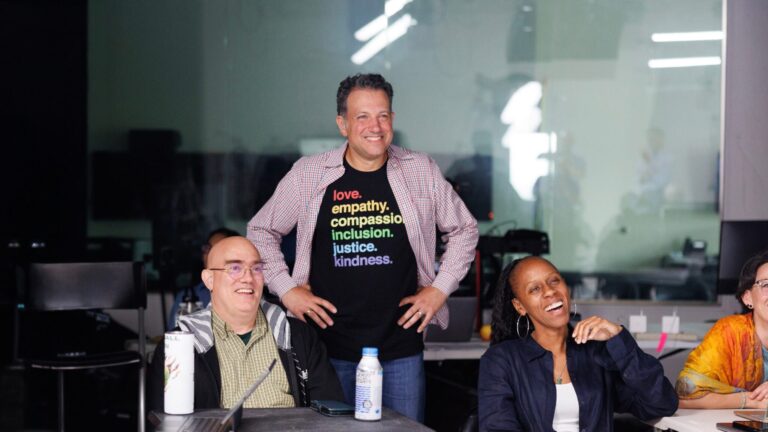
Pictured at top: members of Gallaudet’s AHCP delegation at DeafTech 2026, in Vienna, Austria. Back row, L-R: Abraham Glasser, Bernard Thompson, Michaela Okosi, Christian Vogler, Shuxu Huffman, and Raja Kushalnagar. Front row, L-R: Joe Merino, Charmaine Mendonsa, Luz Calderon Torres, and Lu Ming.
Gallaudet’s Accessible Human-Centered Computing and Policy program integrates computing, design, accessibility, and public policy for students to design, evaluate, and implement evidence-based accessible technologies and policies for diverse audiences. MS and PhD programs are offered. See if an NSF Research Traineeship can power your next steps.