

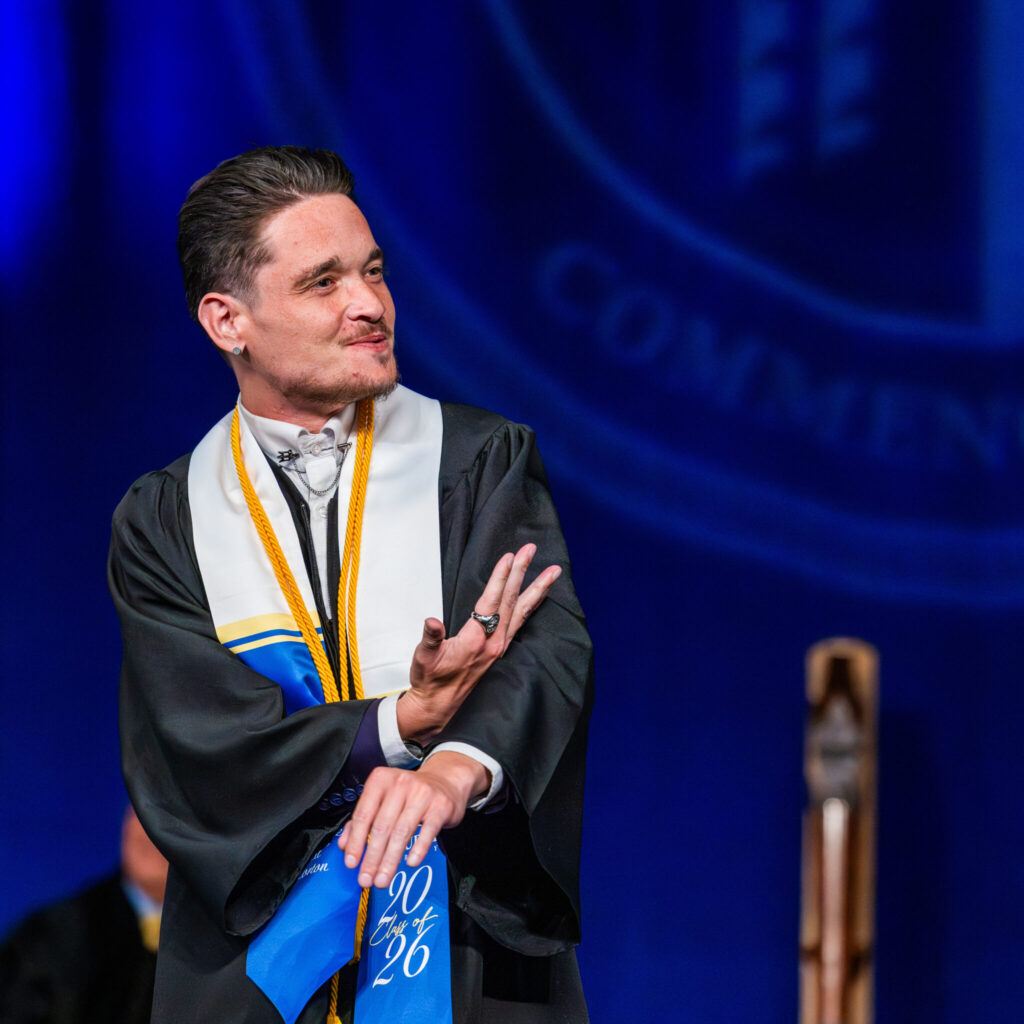
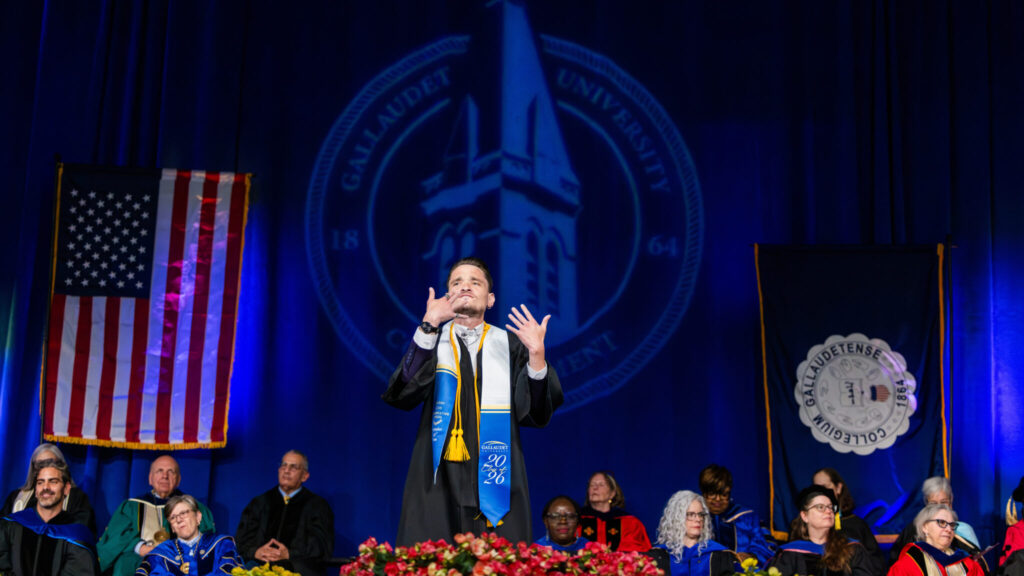
Christopher “Salt” Morton, ’26, couldn’t believe he was here. Here on the Gallaudet campus. About to receive his bachelor’s degree as the first-ever fully online graduate of the Communication Studies program. And standing on the Commencement stage as the Undergraduate Student Speaker.
He looked over the crowd and disbelief crept into his smile while he signed one word.
“Chills.”
Morton roused an enthusiastic cheer from the crowd before launching into an inspiring speech. He leaned into vulnerability by sharing the twists and turns of his life. The latest twist had happened just a month beforehand, when he wasn’t even sure he would graduate at all.
An unexpected ordeal
He couldn’t see, and he didn’t know why.
Morton was in the last semester of a two-year, fully online Communication Studies program. As graduation neared, his vision unexpectedly darkened and narrowed over the course of five months. His eyesight became so bad that he couldn’t follow along with his online classes. He had to step back from his coursework, and even his job.
His teachers worked with him as he navigated the ordeal. They offered one-on-one meetings to replace the class sessions. They also went the extra mile to make their video conferencing backgrounds and clothing more accessible for Morton. He remembers Professor Marina Dzougoutov, ’00, being especially supportive.
“It felt like she cared about my education and wanted to see me thrive,” Morton says.
Dzougoutov remembers Morton as a “thoughtful, engaged, and reflective student who brought a meaningful perspective to online class discussions. He was not only attentive to the course material but also willing to connect ideas to real-life communication ethics and community impact.”
Before Morton’s eye difficulties, he had been able to continue working as a deaf interpreter thanks to the flexibility of the courses. The time between weekly classes was self-paced.
“Time management is easier with online classes,” Morton says. He had diligently completed his coursework for almost two years. However, the problems with his eyesight put him at risk of not graduating at all. Months of doctor’s visits hadn’t resulted in any answers.
It would have been easy for Morton to feel defeated. Instead, he remembered an illuminating conversation from years ago.
A fateful moment
When Morton was a teenager, his father suddenly pulled the car over during a drive and shut the engine off. The two sat in silence for several minutes. Then, Morton’s father rolled up his shirt sleeve to reveal his shoulder. He pointed at a faded tattoo with the letters “C.S.M”. Morton’s initials.
Morton’s father recalled the family’s journey since Morton had been born. In the years following Morton’s birth, he had countless surgeries to address issues with his stomach. The issues impacted his weight and growth. He relied on feeding tubes to get enough calories and nutrients.
As a young child, Morton’s feeding tube ports frequently became infected. At the age of 5 a severe fever caused him to become deaf. Morton’s father and mother struggled to help their son adapt to his new identity. They sent him to speech therapy and got him hearing aids. A few years later, they decided to admit him to a deaf school.
Morton resisted his new reality. “I grew up in the hearing world and I wanted to be hearing like my parents,” he remembers. “I didn’t accept the label ‘deaf’. It took me a few years to take accountability, learn to sign, and accept my deaf identity.”
The awakening would eventually lead Morton to Gallaudet. But not before a few detours along the way.
Moving forward
Following high school, Morton enrolled in a local college but didn’t finish. He worked a series of thankless jobs to get by. In 2018, he met a friend who was in an Interpreter Training Program (ITP). The friend convinced Morton to join, as well. After he completed the program in 2020, he began working as a deaf interpreter for community members.
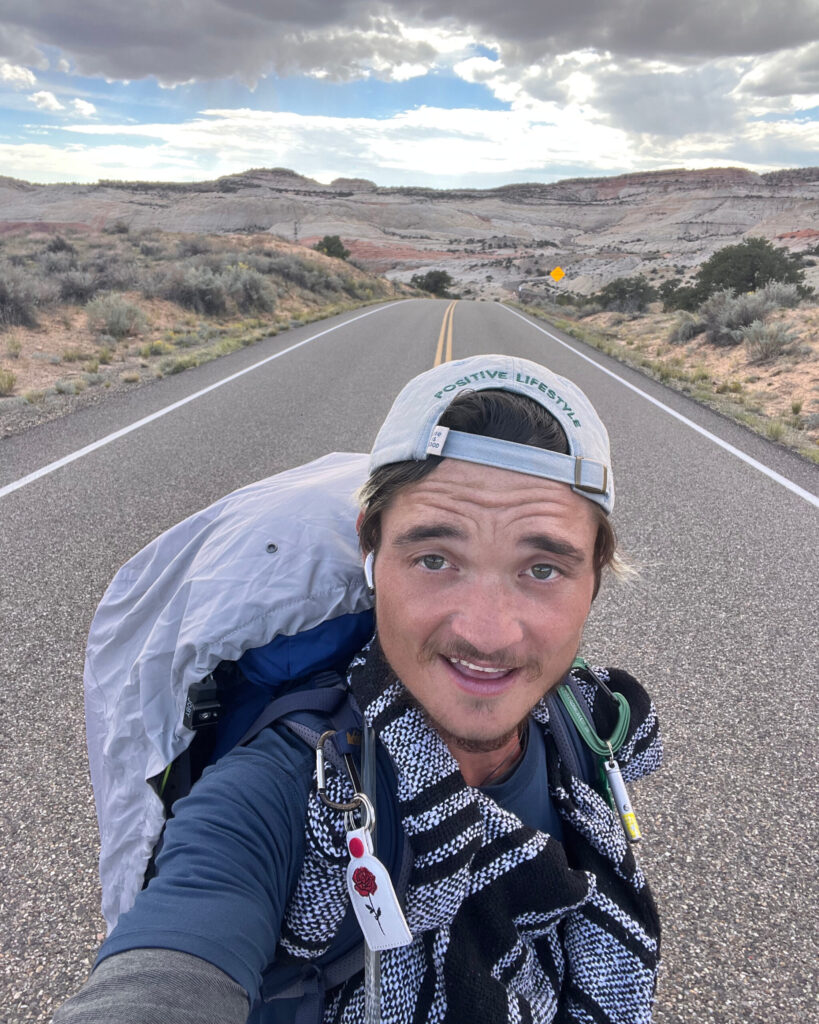
In 2022, two years into the COVID-19 pandemic, Morton decided to put his life on hold and walk across America. The first night of his journey was the first time he had ever camped outdoors. He trekked from California to New Jersey, and returned home with a new perspective on life.
Morton enjoyed working as an interpreter, but wanted to foster more systemic change in the deaf community. To do that, he knew that his resume needed a facelift. It was time to finish his college degree. Once again, Morton got a little help from a friend.
When Claire Clark, G-’26, got accepted to Gallaudet’s Speech Pathology graduate program in 2024, she encouraged Morton to join her on campus. “Salt is the most motivated person I’ve ever seen,” Clark says. “He knows who he is and challenges people to grow.”
“I never thought I would come to Gallaudet,” Morton says. “To be transparent, I always struggled with thinking, ‘Am I deaf enough?’ When Claire encouraged me to come, those feelings came back, but I thought, ‘Let’s see where it goes.’”
Morton’s passions fit the Communication Studies track. “I love public speaking and connecting with people,” Morton says. “And I wanted to experience a deaf immersive environment again. Even though it was online, I feel like I got that.”
During Morton’s final semester, however, his vision difficulties put his hard work at risk. He thought back to that fateful conversation as a teenager in his father’s car.
Putting in the work
Morton’s father had pulled over that day because he could see that his son needed advice. As they sat in the car, he bared his heart.
“When you were born,” Morton’s father said, “the doctor told us you wouldn’t make it. You’re going to face a lot of people who will tell you things that aren’t always true. The doctor said you’d pass, but you’re still here.”
In the years since that conversation, Morton has returned to the memory often. “If you don’t make a decision, the world will decide for you,” Morton says. “If you can’t find a way, make one.”
When doctors couldn’t find the reason why his eyesight had worsened, Morton got to work. Hours of research led him to a possibility that the doctors hadn’t explored yet: Vitamin A deficiency. Testing showed that his Vitamin A levels were far below the typical range.
After being treated with medication and injections, Morton’s vision started returning to normal. In the midst of everything happening, he had also applied to be the Undergraduate Student Speaker at the Commencement 2026 ceremony. He was shocked when he found out that he had been selected. He is the first online-only student to receive the assignment.
“It’s a huge honor,” Morton says. “I want to show other online students that this could happen for them, too, if they put in the work.
“Gallaudet intentionally makes students the priority. That’s how I felt during my online classes. My professors showed up with integrity even when I was sick and gave me the support I needed.”
“Salt is consistently curious and invested in the world around him and met with me to go deeper into the course content,” says Professor Pamela Decker-Wright, ’98. “He asked questions, asked for further connections. Students can choose to just ‘finish tasks,’ or they can choose to ‘learn’ — Salt goes beyond learning to truly understanding and connecting.”
Something bigger
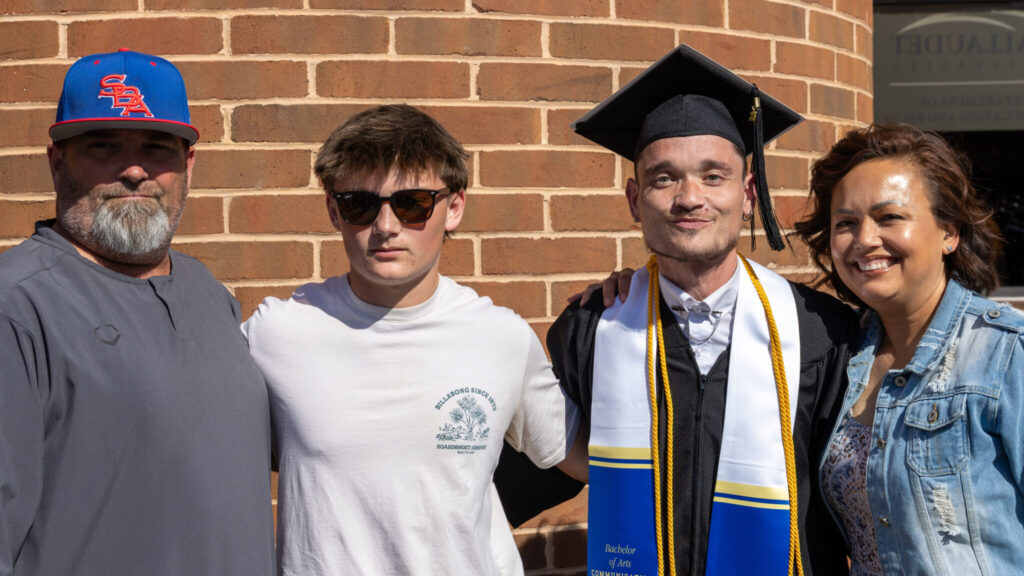
Morton’s Commencement speech touched on the connections he made over the years. He thanked his family, who were seeing his public speaking skills for the first time ever. “If not for your sacrifices, I wouldn’t be here today,” he signed.
Morton also acknowledged the transformative legacy of Gallaudet that he and his peers are tasked with carrying on. As he graduates, he knows that he’s now a part of something bigger than himself.
“Gallaudet is a vital part of the deaf community,” Morton says. “Movements like Deaf President Now helped shift policies in the deaf community’s favor. After all these years, Gallaudet is still here. It’s a symbol of hope.”
Before leading the Commencement crowd in a final cheer, Morton made a promise.
“I’ll be back.”
In fact, he will return in the fall as a graduate student in the International Development Master’s (IDMA) program. And this time, he’ll get the full Gallaudet experience on campus.
“I want to learn policy development and politics to better support the deaf community’s needs,” Morton says. “We need more than just access, we need opportunities. We need a better system so that future generations don’t have to face the same challenges. We need leaders.
“I want the community to trust that somebody is supporting them and has their back. Everything I do is for them.”
Share your brilliance with the world! Gallaudet’s Online Degree Completion Program (ODCP) in Communication Studies allows students to complete their Communication Studies degree through online coursework.